Ulex europaeus
Common gorse
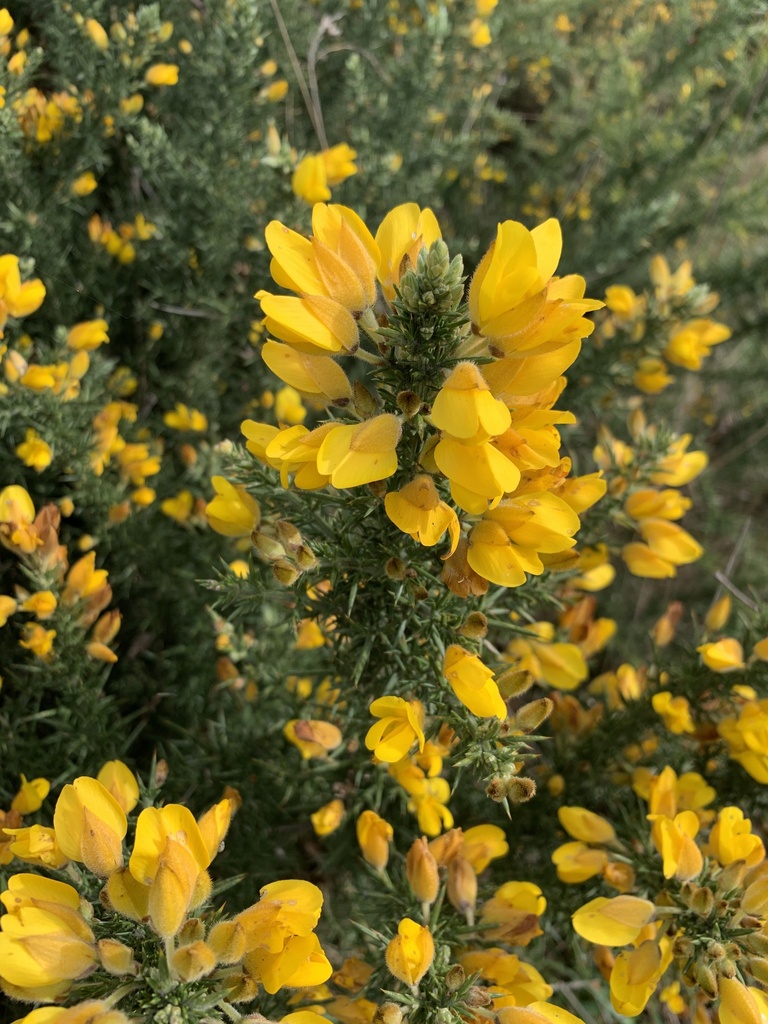
(c) Dave Richardson, some rights reserved (CC BY), uploaded by Dave Richardson · licence
Family: Fabaceae · Type: Shrub · Not Native
Conservation status: Cal-IPC Yes
Ulex europaeus (Common gorse) is a non-native California shrub in the Fabaceae family, recognized by European introduction, no other Ulex species established in California.
Common gorse is a naturalized shrub found in northern coastal California, central coast, and southern coastal regions in disturbed places like old fields and pastures at elevations below 400 meters. Flowering from April to July, this plant produces bright yellow flowers with dense clusters of pea-like blossoms about 20 millimeters long. Growing as a dense, intricately branched shrub up to 3 meters tall with stiff, hairy twigs that become more complex with age, it forms thick, impenetrable thickets. Its leaves are reduced to sharp, rigid spines, giving the plant a distinctive, prickly appearance that makes it easily recognizable in disturbed landscapes. The fruit develops as a densely hairy pod 1 to 2 centimeters long, contributing to its persistent and aggressive growth habit.
Identification and appearance
Key characters: European introduction, no other Ulex species established in California
Habitat and range
Habitat: Common. Disturbed places, especially old fields, pastures
Elevation: < 400 m
California counties: Sonoma, Mendocino, San Mateo, Monterey, Marin, Los Angeles, Santa Cruz, Placer, Nevada, Humboldt, Calaveras, Alameda, San Francisco, Del Norte, Butte, Contra Costa, San Diego, Santa Barbara
Outside California: native to western Europe
Bloom period
Ulex europaeus blooms Apr-Jul.
Conservation status
Cal-IPC Yes
How to tell it apart
vs Genista: Ulex has spines covering the entire plant; Genista has few or no spines and green photosynthetic stems.; vs Lupinus: Ulex forms impenetrable spiny shrubs; Lupinus has soft herbaceous stems without spines.; vs Isocoma: Ulex has yellow pea-shaped flowers; Isocoma has yellow composite flower heads with ray and disk flowers.; vs Alhagi: Ulex has yellow flowers and densely hairy pods; Alhagi has red-purple flowers and smooth beaded pods.; vs Psorothamnus: Ulex has densely hairy non-glandular pods; Psorothamnus has smooth gland-dotted pods.
Frequently asked questions
Is Ulex europaeus native to California?
No. Ulex europaeus is not native to California (recorded as not native).
When does Ulex europaeus bloom?
Ulex europaeus blooms Apr-Jul.
Where in California does Ulex europaeus grow?
Ulex europaeus occurs in Sonoma, Mendocino, San Mateo, Monterey, Marin, Los Angeles, Santa Cruz, Placer and other counties, at elevations of < 400 m.
What plant family does Ulex europaeus belong to?
Ulex europaeus is in the Fabaceae family, genus Ulex.
Is Ulex europaeus invasive in California?
Ulex europaeus is listed by Cal-IPC with an invasiveness rating of Yes.
Related species
Other California species in the same genus, family, or bioregion.
Sources: Jepson eFlora · Index of California Plant Names · CalPhotos
Last updated 2026-10-07
Data from The California Species Project — 14,000+ California species with verified data from CNPS, CDFW, USFWS, Cal-IPC, and more.