Umbellularia californica
Bay laurel
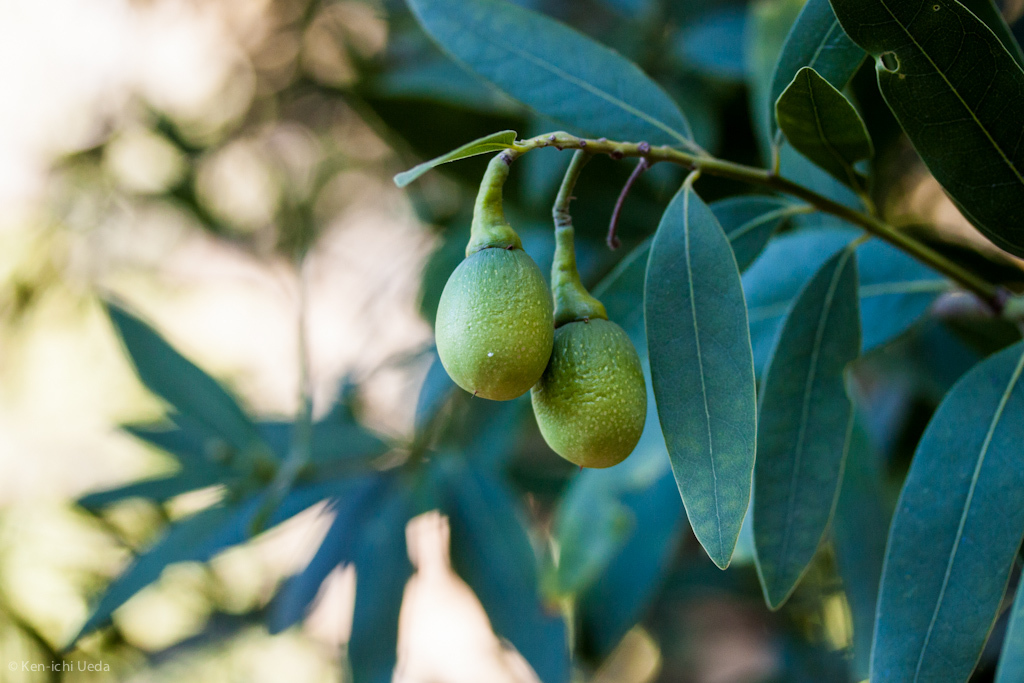
(c) Ken-ichi Ueda, some rights reserved (CC BY) · licence
Family: Lauraceae · Type: Shrub / Tree · Native
Umbellularia californica (Bay laurel) is a native California shrub / tree in the Lauraceae family, recognized by Only member of genus Umbellularia, endemic to California and southern Oregon.
Bay laurel is a California native shrub found in northwestern California, the Cascade Range foothills, Sierra Nevada, Sutter Buttes, delta region, Coast Ranges, San Francisco Bay Area, southern California, and scattered transverse and peninsular ranges in canyons, valleys, and chaparral at elevations below 1,600 meters. Flowering from November to May, this plant produces small umbel-like clusters of pale greenish-white flowers less than 5 millimeters long. Growing up to 45 meters tall with bark ranging from green to red-brown, it develops a dense, spreading form with multiple trunks. Its leaves are shiny deep yellow-green, narrowly ovate to oblong, 3 to 10 centimeters long with minute gland dots, and have a distinctive glossy appearance. The fruit is an olive-like drupe 2 to 3 centimeters long, turning dark purple when dry.
Identification and appearance
Key characters: Only member of genus Umbellularia, endemic to California and southern Oregon
Habitat and range
Habitat: Common. Canyons, valleys, chaparral
Elevation: < 1600 m
California counties: Humboldt, Los Angeles, Solano, Alameda, Butte, Contra Costa, Del Norte, El Dorado, Fresno, Glenn, Kern, Lake, Madera, Marin, Mariposa, Mendocino, Monterey, Napa, Nevada, Orange, Riverside, San Bernardino, San Diego, San Francisco, San Luis Obispo, San Mateo, Santa Barbara, Santa Clara, Santa Cruz, Shasta, Siskiyou, Sonoma, Tulare, Ventura, Placer, Plumas, Trinity, Calaveras, Amador, Tuolumne, Sutter, Tehama, Colusa, Yolo, Stanislaus, Lassen, Yuba
Outside California: southern Oregon
Bloom period
Umbellularia californica blooms Nov-May.
How to tell it apart
vs Laurus: Both are aromatic evergreen laurels with glossy elliptic leaves, but California bay leaves give off a powerful, peppery-camphor scent (strong enough to sting the sinuses) and are borne on nearly flat margins, while true bay laurel has a milder, sweeter aroma and distinctly wavy leaf margins.; vs Cinnamomum: Camphor tree leaves are triple-veined, with two prominent side veins arching up from near the leaf base, whereas Umbellularia leaves are simply pinnately veined with a single midrib.; vs Persea: Avocado leaves are much larger (6-25 cm) and duller, and the tree bears a large fleshy fruit, unlike California bay's smaller shiny leaves and olive-sized drupe seated in a shallow cup.; vs Prunus: Evergreen cherries like hollyleaf cherry are also shiny-leaved sclerophylls, but their leaves are often spiny-toothed and not aromatic, and their flowers are 5-petaled and borne in elongate racemes rather than small stalked umbels.; vs Morella: Wax myrtle is an aromatic evergreen shrub with narrow leaves too, but its blades are toothed and dotted with resin glands giving a sweet-resinous (not spicy-camphor) smell, and its fruit is a bumpy wax-coated nutlet.
Frequently asked questions
Is Umbellularia californica native to California?
Yes. Umbellularia californica is native to California (recorded as native).
When does Umbellularia californica bloom?
Umbellularia californica blooms Nov-May.
Where in California does Umbellularia californica grow?
Umbellularia californica occurs in Humboldt, Los Angeles, Solano, Alameda, Butte, Contra Costa, Del Norte, El Dorado and other counties, at elevations of < 1600 m.
What plant family does Umbellularia californica belong to?
Umbellularia californica is in the Lauraceae family, genus Umbellularia.
What habitat does Umbellularia californica grow in?
Umbellularia californica grows in Common. Canyons, valleys, chaparral.
Related species
Other California species in the same genus, family, or bioregion.
Sources: Jepson eFlora · Index of California Plant Names · CalPhotos
Last updated 2026-10-07
Data from The California Species Project — 14,000+ California species with verified data from CNPS, CDFW, USFWS, Cal-IPC, and more.