Urtica urens
Dwarf nettle, Dwarf Nettle
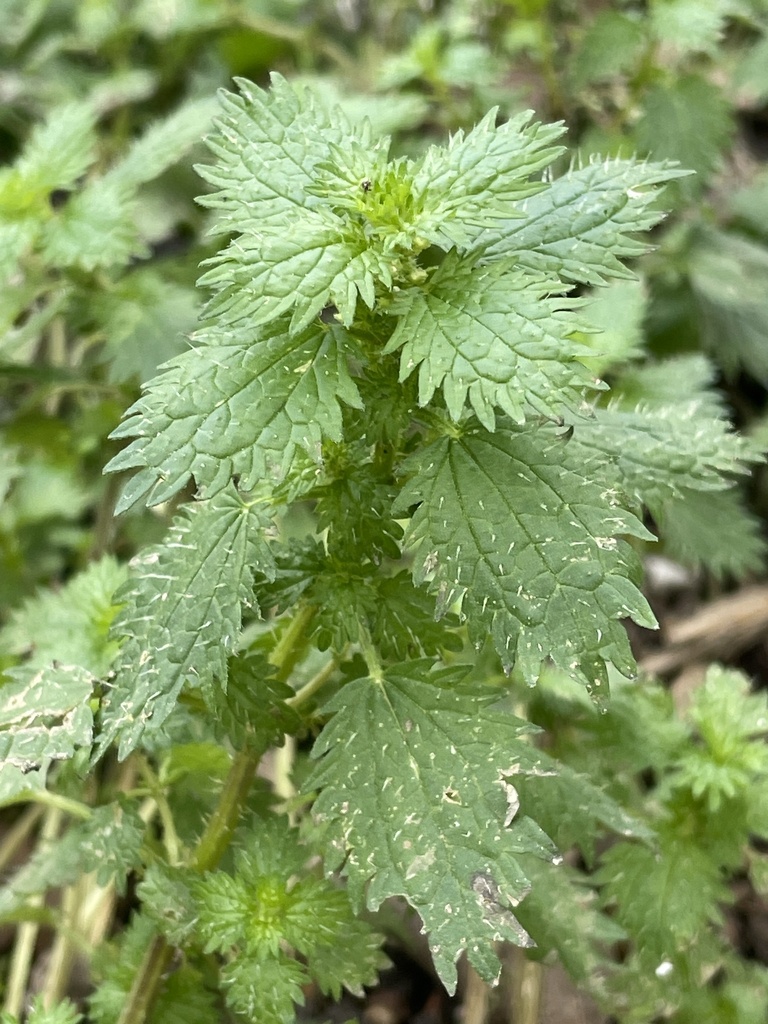
no rights reserved · CC0
Family: Urticaceae · Type: Herb · Not Native
Urtica urens (Dwarf nettle) is a non-native California herb in the Urticaceae family, recognized by Co-occurs with 3 congeners; clearly distinct as only annual species with small stature.
Dwarf nettle is a naturalized annual herb found in northern and central California regions including the Coast Ranges, Sierra Nevada foothills, Central Valley, and southern California coastal areas in disturbed areas, stream banks, and shaded habitats at elevations below 1,000 meters. Flowering from January to June, this plant produces small green flowers in compact head-like or spike-like clusters measuring 5 to 25 millimeters long. Growing to 10 to 60 centimeters tall with simple or branched erect stems emerging from a slender taproot, it develops quickly in disturbed landscapes. Its leaves are elliptical to broadly elliptical, 18 to 40 millimeters long with coarse-serrated margins and a wedge-shaped base, creating a distinctive textured appearance. The fruit is small, deltate-shaped and measuring 1.5 to 2.5 millimeters long.
Identification and appearance
Key characters: Co-occurs with 3 congeners; clearly distinct as only annual species with small stature
Habitat and range
Habitat: Disturbed areas, stream banks, shaded areas in grassland, oak woodland, chaparral, coastal-sage scrub, riparian woodland
Elevation: < 1000 m
California counties: Los Angeles, Ventura, San Luis Obispo, Kern, Tulare, Riverside, Orange, San Mateo, San Diego, San Bernardino, Alameda, Santa Clara, Fresno, Monterey, San Francisco, Imperial, Santa Barbara, Colusa, San Joaquin, Stanislaus, Sacramento, Amador, Butte, Calaveras, Madera, Mendocino, Napa, Nevada, San Benito, Santa Cruz, Marin, Contra Costa, Sutter, Merced, Tehama, Placer, Humboldt, Sonoma, Modoc, Solano, Mariposa
Outside California: native to Europe
Bloom period
Urtica urens blooms Jan-Jun.
How to tell it apart
vs Hesperocnide: Urtica has 4 separate unequal sepals; Hesperocnide has 2-4 fused equal sepals.; vs Scrophularia: Urtica has stinging hairs; Scrophularia is safe to touch.; vs Stachys: Urtica stings and has tiny nettle flowers; Stachys is safe with tubular mint flowers.; vs Phacelia: Urtica has opposite leaves and stings; Phacelia has coiled flower clusters and doesn't sting.; vs Rubus: Urtica has stinging hairs on herbaceous stems; Rubus has thorns on woody canes.
Frequently asked questions
Is Urtica urens native to California?
No. Urtica urens is not native to California (recorded as not native).
When does Urtica urens bloom?
Urtica urens blooms Jan-Jun.
Where in California does Urtica urens grow?
Urtica urens occurs in Los Angeles, Ventura, San Luis Obispo, Kern, Tulare, Riverside, Orange, San Mateo and other counties, at elevations of < 1000 m.
What plant family does Urtica urens belong to?
Urtica urens is in the Urticaceae family, genus Urtica.
What habitat does Urtica urens grow in?
Urtica urens grows in Disturbed areas, stream banks, shaded areas in grassland, oak woodland, chaparral, coastal-sage scrub, riparian woodland.
Related species
Other California species in the same genus, family, or bioregion.
Sources: Jepson eFlora · Index of California Plant Names · CalPhotos
Last updated 2026-10-07
Data from The California Species Project — 14,000+ California species with verified data from CNPS, CDFW, USFWS, Cal-IPC, and more.