Utricularia macrorhiza
Common bladderwort
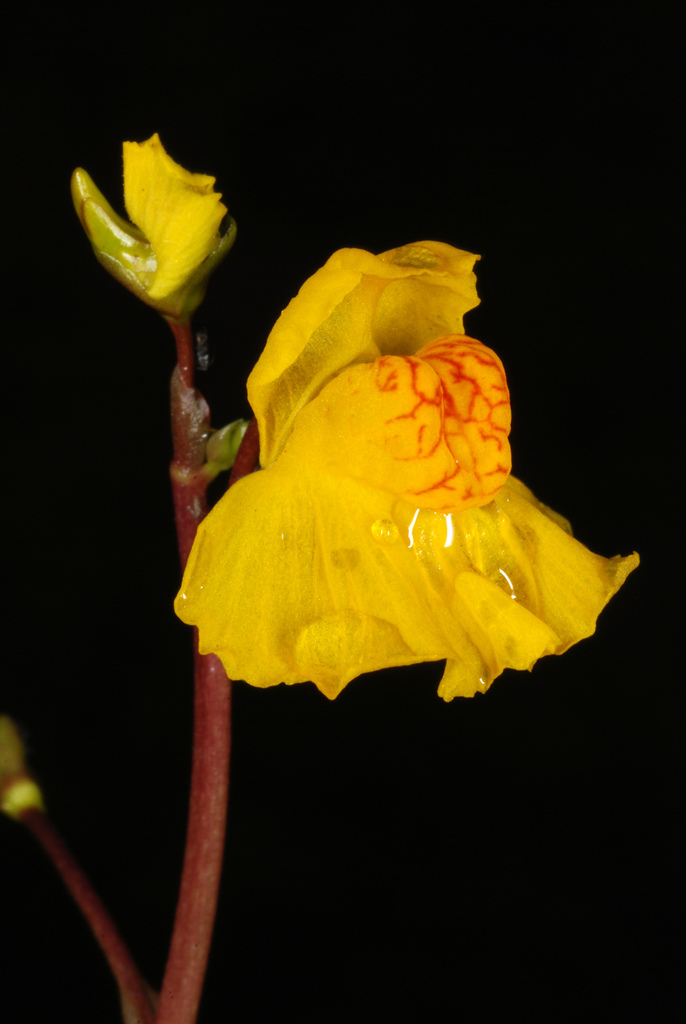
(c) Douglas Goldman, some rights reserved (CC BY-SA), uploaded by Douglas Goldman · licence
Family: Lentibulariaceae · Type: Herb · Native
Utricularia macrorhiza (Common bladderwort) is a native California herb in the Lentibulariaceae family, recognized by largest size and robust flower stalks diagnostic.
Common bladderwort is a native perennial found in northwestern California, Cascade Range, Sierra Nevada, San Francisco Bay Area, San Bernardy Mountains, Great Basin, and western Mojave Desert in quiet, shallow or deep, rarely flowing, acidic waters at elevations below 2,700 meters. Flowering from June to September, this aquatic plant produces yellow flowers with a distinctive lower lip larger than the upper lip, blooming on stout peduncles one to four decimeters long. Growing as a floating aquatic with a well-defined central stolon, it develops intricate leaves divided into 30 to 150 thread-like segments with delicate ultimate segments. Its complex leaves are one to two-parted at the base, each part unequally pinnately dissected, with bladders near the base larger than those near the tip. Winter buds one to two centimeters long with bristly texture help the plant survive seasonal changes in its aquatic habitat.
Identification and appearance
Key characters: 4 sympatric species; largest size and robust flower stalks diagnostic
Habitat and range
Habitat: Quiet, shallow or deep, rarely flowing, acidic waters
Elevation: < 2700 m
California counties: Modoc, Lake, Placer, Nevada, Siskiyou, Tulare, Fresno, San Joaquin, Alpine, Lassen, San Bernardino, Mono, Del Norte, Plumas, Tuolumne, Merced, El Dorado, Inyo, San Mateo, Madera, Humboldt, Marin, Mendocino, Tehama, Mariposa, Sierra, Butte
Outside California: North America except extreme southeastern, northeastern Mexico, eastern Asia
Bloom period
Utricularia macrorhiza blooms Jun-Sep.
How to tell it apart
vs Pinguicula: Utricularia has yellow flowers and grows aquatic, while Pinguicula has blue-violet flowers on land.; vs Proboscidea: Utricularia has thread-like dissected parts in water, while Proboscidea has large solid leaves on land.; vs Mimulus: Utricularia has finely dissected underwater parts, while Mimulus has normal solid leaves.; vs Limosella: Utricularia has thread-like dissected parts, while Limosella has simple spoon-shaped leaves.; vs Synthyris: Utricularia is aquatic with dissected parts, while Synthyris is terrestrial with simple toothed leaves.
Frequently asked questions
Is Utricularia macrorhiza native to California?
Yes. Utricularia macrorhiza is native to California (recorded as native).
When does Utricularia macrorhiza bloom?
Utricularia macrorhiza blooms Jun-Sep.
Where in California does Utricularia macrorhiza grow?
Utricularia macrorhiza occurs in Modoc, Lake, Placer, Nevada, Siskiyou, Tulare, Fresno, San Joaquin and other counties, at elevations of < 2700 m.
What plant family does Utricularia macrorhiza belong to?
Utricularia macrorhiza is in the Lentibulariaceae family, genus Utricularia.
What habitat does Utricularia macrorhiza grow in?
Utricularia macrorhiza grows in Quiet, shallow or deep, rarely flowing, acidic waters.
Related species
Other California species in the same genus, family, or bioregion.
Sources: Jepson eFlora · Index of California Plant Names · CalPhotos
Last updated 2026-10-07
Data from The California Species Project — 14,000+ California species with verified data from CNPS, CDFW, USFWS, Cal-IPC, and more.