Vaccinium deliciosum
Cascade bilberry
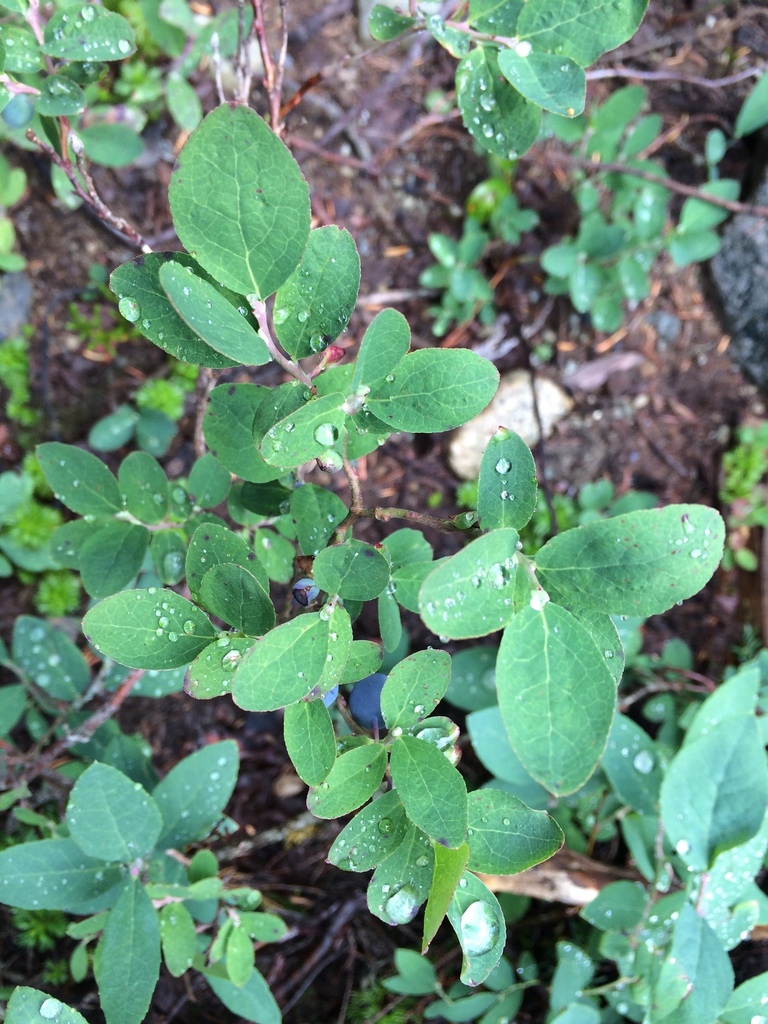
(c) Maddie Edmonds, some rights reserved (CC BY) · licence
Family: Ericaceae · Type: Shrub · Native
Vaccinium deliciosum (Cascade bilberry) is a native California shrub in the Ericaceae family, recognized by glaucous leaves, large fruits >9mm, and matted habit.
Cascade bilberry is a California native shrub found in the Klamath Ranges, northern Sierra Nevada, and Warner Mountains in alpine meadows and subalpine conifer forests at elevations of 600 to 2,000 meters. Flowering from June to July, this plant produces small pink, spherical flowers less than 6 millimeters long in leaf axils. Growing as a low, matted shrub less than 4 decimeters tall with weakly angled, glaucous twigs that often root at the base, it forms dense ground-covering patches. Its deciduous leaves are obovate to oblanceolate, 1.5 to 3.5 centimeters long, with serrated edges along the upper two-thirds and a blue-glaucous surface. The fruit is a distinctive blue-glaucous berry more than 9 millimeters wide, making it a prized wild edible in alpine environments.
Identification and appearance
Key characters: 9 sympatric species; key features are glaucous leaves, large fruits >9mm, and matted habit
Habitat and range
Habitat: Alpine meadows, subalpine conifer forest, near coast
Elevation: 600-2000 m
Outside California: to British Columbia
Bloom period
Vaccinium deliciosum blooms Jun-Jul.
Frequently asked questions
Is Vaccinium deliciosum native to California?
Yes. Vaccinium deliciosum is native to California (recorded as native).
When does Vaccinium deliciosum bloom?
Vaccinium deliciosum blooms Jun-Jul.
What plant family does Vaccinium deliciosum belong to?
Vaccinium deliciosum is in the Ericaceae family, genus Vaccinium.
What habitat does Vaccinium deliciosum grow in?
Vaccinium deliciosum grows in Alpine meadows, subalpine conifer forest, near coast.
Related species
Other California species in the same genus, family, or bioregion.
Sources: Jepson eFlora · CalPhotos
Last updated 2026-10-07
Data from The California Species Project — 14,000+ California species with verified data from CNPS, CDFW, USFWS, Cal-IPC, and more.