Ventenata dubia
North africa grass
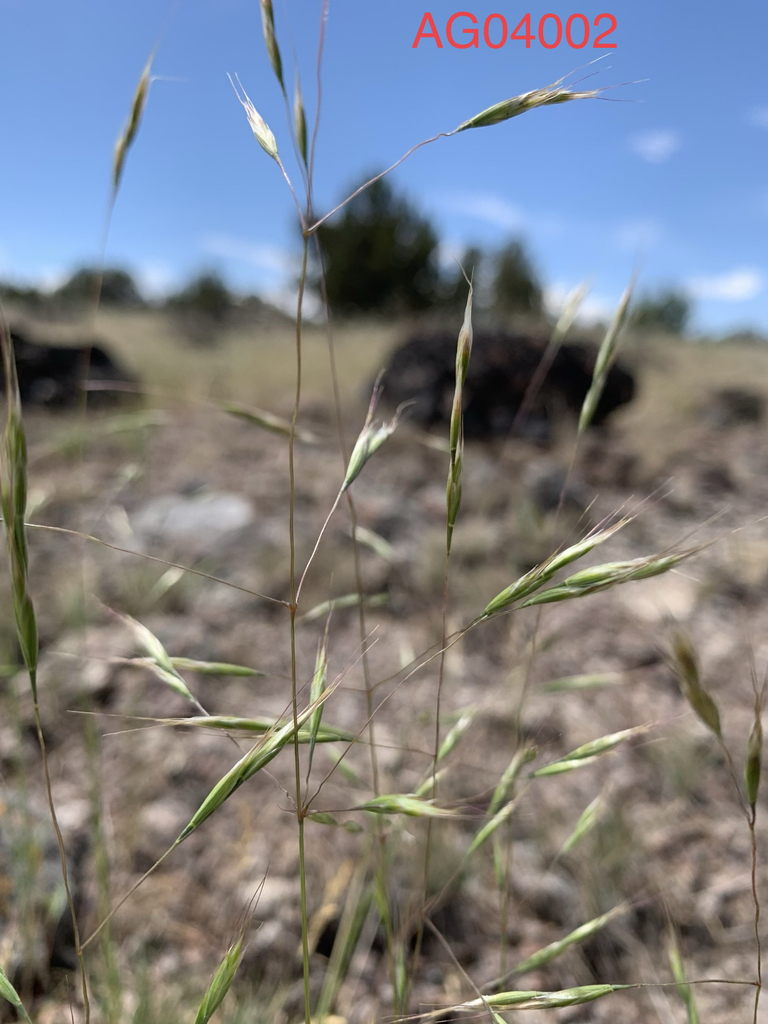
(c) mark-groeneveld, some rights reserved (CC BY), uploaded by mark-groeneveld · licence
Family: Poaceae · Type: Grass · Not Native
Conservation status: Cal-IPC Yes
Ventenata dubia (North africa grass) is a non-native California grass in the Poaceae family, recognized by Recent European introduction, only Ventenata species naturalized in California.
North africa grass is a naturalized annual grass found in the Klamath Ranges, northern Coast Ranges, California Ranges, northern Sierra Nevada, and Modoc Plateau in dry, open disturbed sites at elevations of 500 to 1,500 meters. Flowering from June to September, this grass produces delicate, pale spikelets with spreading to drooping branches 15 to 20 centimeters long. Growing with slender stems featuring distinctive purple-black nodes, it spreads in open habitats with thin, rolled leaves 2 to 7 centimeters long. Its leaves have narrow blades approximately 1 to 3 millimeters wide that gradually curl under with age, creating a distinctive fine-textured appearance. The spikelets are 10 to 15 millimeters long, with lanceolate glumes and florets bearing straight awns up to 1.5 centimeters long.
Identification and appearance
Key characters: Recent European introduction, only Ventenata species naturalized in California
Habitat and range
Habitat: Dry, open disturbed sites
Elevation: 500-1500 m
California counties: Shasta, Modoc, Lassen, Siskiyou, Lake, Trinity, Humboldt, Mariposa, Placer
Outside California: to Canada, northeastern United States, native to central and southern Europe
Bloom period
Ventenata dubia blooms Jun-Sep.
Conservation status
Cal-IPC Yes
How to tell it apart
vs Avena: Both show open, drooping panicles of awned spikelets, but wild oats have much larger spikelets (over 2 cm) with big papery glumes wrapping the florets, while Ventenata spikelets are finer (about 1-1.5 cm) and its stem nodes are shiny purple-black.; vs Bromus: Bromes have many-flowered spikelets with awns arising just below the lemma tips, whereas Ventenata has only 2-3 florets per spikelet and bears bent, twisted awns on the upper florets while the lowest floret is awnless and staminate.; vs Aira: Hairgrasses are delicate annuals with airy panicles too, but their spikelets are tiny (about 3 mm, 2-flowered), against Ventenata's larger 10-15 mm spikelets and diagnostic dark nodes.; vs Deschampsia: Tufted hairgrass has an open shiny panicle of small awned florets but is a perennial bunchgrass with straight to weakly bent awns and green nodes, unlike Ventenata's annual habit and blackened nodes.; vs Trisetum: Trisetum also carries small awned florets in an open to contracted panicle, but Ventenata is distinguished by its awnless staminate lowest floret and the sharply geniculate, twisted awns of the florets above.
Frequently asked questions
Is Ventenata dubia native to California?
No. Ventenata dubia is not native to California (recorded as not native).
When does Ventenata dubia bloom?
Ventenata dubia blooms Jun-Sep.
Where in California does Ventenata dubia grow?
Ventenata dubia occurs in Shasta, Modoc, Lassen, Siskiyou, Lake, Trinity, Humboldt, Mariposa and other counties, at elevations of 500-1500 m.
What plant family does Ventenata dubia belong to?
Ventenata dubia is in the Poaceae family, genus Ventenata.
Is Ventenata dubia invasive in California?
Ventenata dubia is listed by Cal-IPC with an invasiveness rating of Yes.
Related species
Other California species in the same genus, family, or bioregion.
Sources: Jepson eFlora · Index of California Plant Names · CalPhotos
Last updated 2026-10-07
Data from The California Species Project — 14,000+ California species with verified data from CNPS, CDFW, USFWS, Cal-IPC, and more.