Veratrum californicum var. californicum
California corn lily
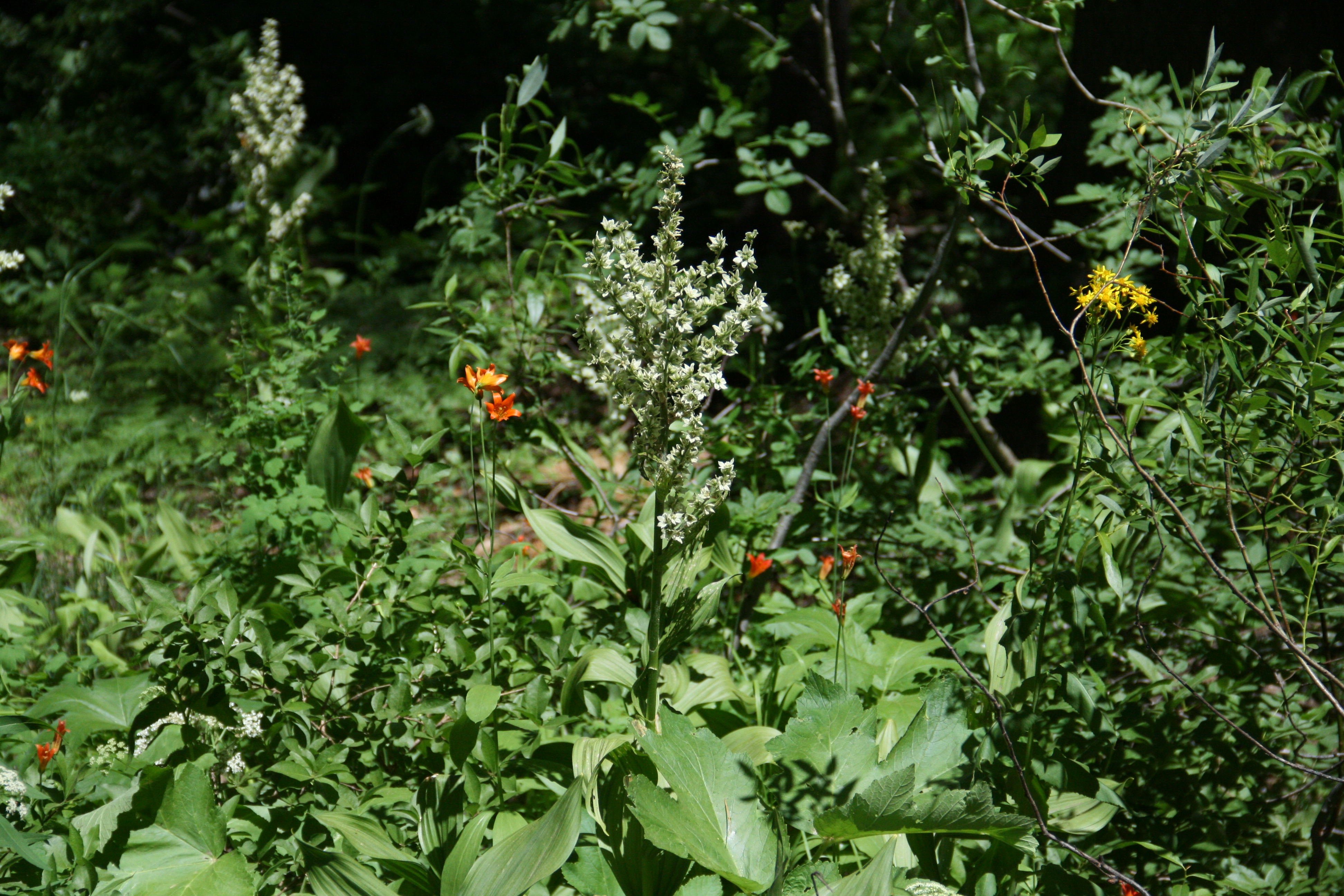
Photo by Chez Brungraber
Family: Melanthiaceae · Type: Herb · Native
Veratrum californicum var. californicum (California corn lily) is a native California herb in the Melanthiaceae family, recognized by petal margins and inflorescence structure.
California corn lily is a California native perennial found in northwestern California, Cascade Range, Sierra Nevada, Transverse Ranges, Peninsular Ranges, Modoc Plateau, and Sierra Nevada Eastern Slopes in streambanks, moist meadows, and forest edges at elevations up to 3,500 meters. Flowering from July to August, this plant produces white to green flowers 10 to 15 millimeters long in dense, spreading inflorescences. Growing with robust stems 30 to 60 centimeters tall and a dense, woolly flowering structure, it forms impressive clusters in moist mountain habitats. Its large lower leaves are ovate, 20 to 40 centimeters long, with hairy margins and undersides that have a distinctive curly texture. The fruit develops as a narrowly ovoid capsule 2 to 3 centimeters long, containing winged seeds 10 to 12 millimeters in size.
Identification and appearance
Key characters: 3 sympatric species; distinguished by petal margins and inflorescence structure
Habitat and range
Habitat: Streambanks, moist meadows, forest edges
Elevation: < 3500 m
California counties: Los Angeles, Mariposa, Mono, San Bernardino, Inyo, Modoc, Tulare, El Dorado, Alpine, Amador, Nevada, Placer, Del Norte, Glenn, Lake, Riverside, San Diego, Shasta, Tehama, Trinity, Calaveras, Siskiyou, Lassen, Butte, Sierra, Yuba, Tuolumne, Humboldt, Plumas, Colusa, Mendocino, Kern, Fresno, Madera
Outside California: to Washington, Montana, Colorado, Mexico
Bloom period
Veratrum californicum var. californicum blooms Jul-Aug.
How to tell it apart
vs Epipactis: Veratrum has large pleated leaves and branching flower clusters; Epipactis has smaller smooth leaves and orchid-type flowers in one spike.; vs Maianthemum: Veratrum is 3-6 feet tall with large pleated leaves; Maianthemum is under 2 feet with smooth heart-shaped leaves.; vs Toxicoscordion: Veratrum has large pleated leaves arranged up a tall stem; Toxicoscordion has narrow grass-like basal leaves.; vs Stachys: Veratrum has large pleated alternate leaves; Stachys has smaller opposite leaves and square stems.; vs Symplocarpus: Veratrum has pleated leaves up a tall stem; Symplocarpus has large basal leaves and a hooded flower spike.
Frequently asked questions
Is Veratrum californicum var. californicum native to California?
Yes. Veratrum californicum var. californicum is native to California (recorded as native).
When does Veratrum californicum var. californicum bloom?
Veratrum californicum var. californicum blooms Jul-Aug.
Where in California does Veratrum californicum var. californicum grow?
Veratrum californicum var. californicum occurs in Los Angeles, Mariposa, Mono, San Bernardino, Inyo, Modoc, Tulare, El Dorado and other counties, at elevations of < 3500 m.
What plant family does Veratrum californicum var. californicum belong to?
Veratrum californicum var. californicum is in the Melanthiaceae family, genus Veratrum.
What habitat does Veratrum californicum var. californicum grow in?
Veratrum californicum var. californicum grows in Streambanks, moist meadows, forest edges.
Related species
Other California species in the same genus, family, or bioregion.
Sources: Jepson eFlora · Index of California Plant Names · CalPhotos
Last updated 2026-10-07
Data from The California Species Project — 14,000+ California species with verified data from CNPS, CDFW, USFWS, Cal-IPC, and more.