Verbascum thapsus
Woolly mullein, Woolly Mullein
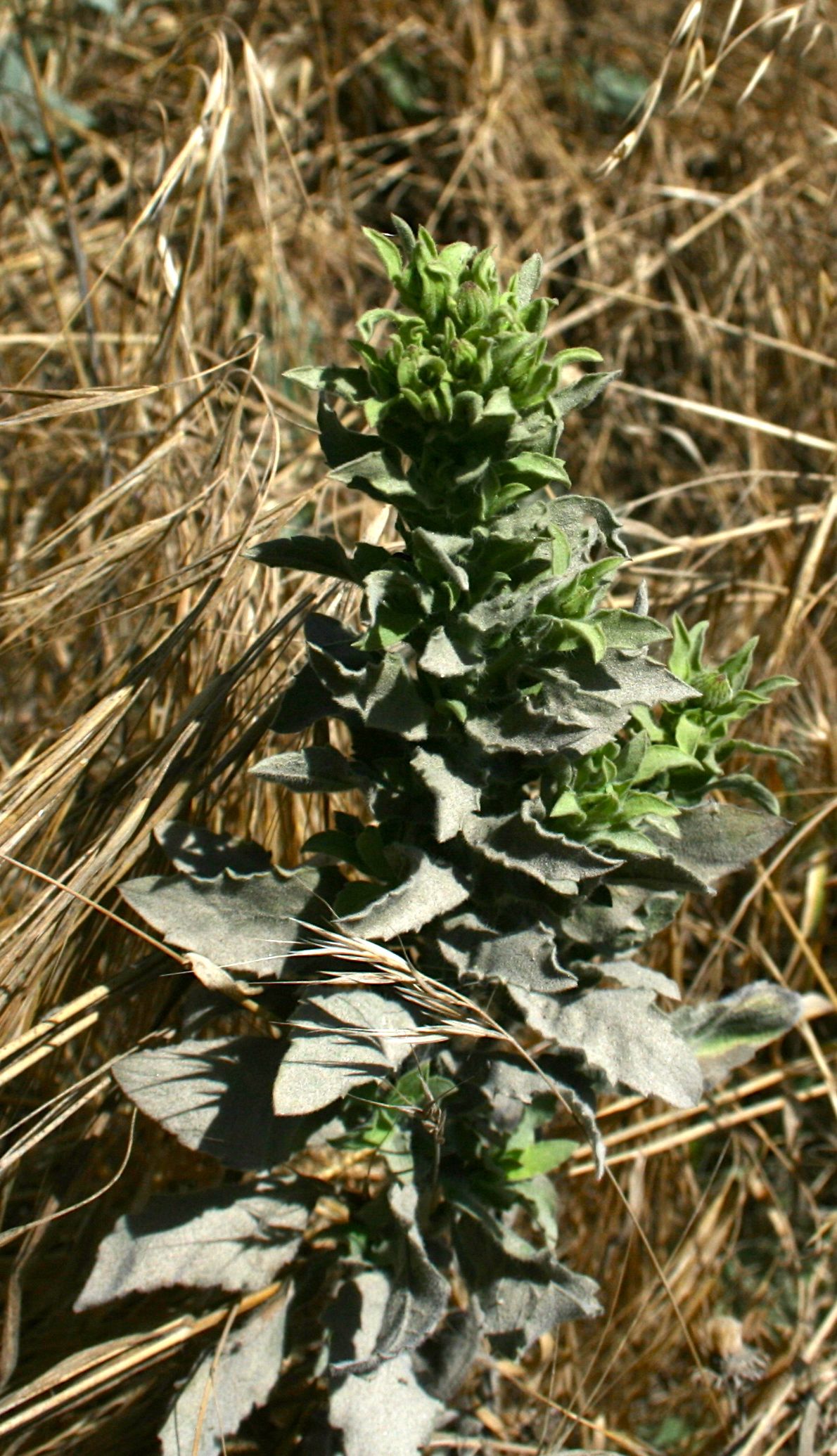
Photo by Chez Brungraber
Family: Scrophulariaceae · Type: Herb · Not Native
Conservation status: Cal-IPC Yes
Verbascum thapsus (Woolly mullein) is a non-native California herb in the Scrophulariaceae family.
Woolly mullein is a naturalized plant found in California foothills, northern Sierra Nevada, and Mojave Plateau in roadsides, streambanks, and disturbed areas at elevations up to 2,470 meters. Flowering from May to September, this plant produces large yellow flowers 15 to 25 millimeters wide with distinctive white- or yellow-hairy upper stamens. Growing with densely woolly stems 30 to 200 centimeters tall, it develops as a striking vertical plant with a simple unbranched structure. Its leaves form a dramatic rosette, with large basal leaves 8 to 50 centimeters long, oblanceolate and generally entire, transitioning to smaller lance-shaped sessile leaves that run down the stem. The dense, tall raceme of yellow blossoms creates a prominent landmark in disturbed landscapes, making this plant easily recognizable even from a distance.
Identification and appearance
Key characters: Co-occurs with 4 species; key differentiator is decurrent leaves and dense raceme with sessile flowers
Habitat and range
Habitat: Roadsides, streambanks, disturbed areas
Elevation: < 2470 m
California counties: Lake, Santa Barbara, Los Angeles, Tulare, San Bernardino, San Mateo, Trinity, Plumas, Merced, Inyo, Tuolumne, Placer, Riverside, Butte, San Diego, Mono, Siskiyou, Lassen, Modoc, Santa Clara, Mendocino, Humboldt, Kern, Orange, El Dorado, Nevada, Amador, Calaveras, Sierra, Sonoma, Solano, Alpine, Alameda, San Luis Obispo, Sacramento, Shasta, Sutter, Tehama, Glenn, Colusa, Yolo, Stanislaus, San Joaquin, Santa Cruz, Napa, Fresno, Del Norte, Madera, Monterey, Mariposa, San Benito
Outside California: native to Eurasia
Bloom period
Verbascum thapsus blooms May-Sep.
Conservation status
Cal-IPC Yes
How to tell it apart
vs Stachys: Verbascum has nearly radial flowers in tall spikes; Stachys has bilateral flowers in whorled clusters.; vs Heterotheca: Verbascum has 5-petaled flowers with fuzzy stamens; Heterotheca has composite flower heads with ray and disk flowers.; vs Croton: Verbascum has showy yellow petaled flowers; Croton has tiny flowers without petals.; vs Oenothera: Verbascum has 5 stamens and fuzzy stalks; Oenothera has 8 stamens and smooth flower parts.; vs Dipsacus: Verbascum has individual flowers along spike; Dipsacus has flowers in dense, spiny, rounded heads.
Frequently asked questions
Is Verbascum thapsus native to California?
No. Verbascum thapsus is not native to California (recorded as not native).
When does Verbascum thapsus bloom?
Verbascum thapsus blooms May-Sep.
Where in California does Verbascum thapsus grow?
Verbascum thapsus occurs in Lake, Santa Barbara, Los Angeles, Tulare, San Bernardino, San Mateo, Trinity, Plumas and other counties, at elevations of < 2470 m.
What plant family does Verbascum thapsus belong to?
Verbascum thapsus is in the Scrophulariaceae family, genus Verbascum.
Is Verbascum thapsus invasive in California?
Verbascum thapsus is listed by Cal-IPC with an invasiveness rating of Yes.
Related species
Other California species in the same genus, family, or bioregion.
Sources: Jepson eFlora · Index of California Plant Names · CalPhotos
Last updated 2026-10-07
Data from The California Species Project — 14,000+ California species with verified data from CNPS, CDFW, USFWS, Cal-IPC, and more.