Verbascum virgatum
Wand mullein
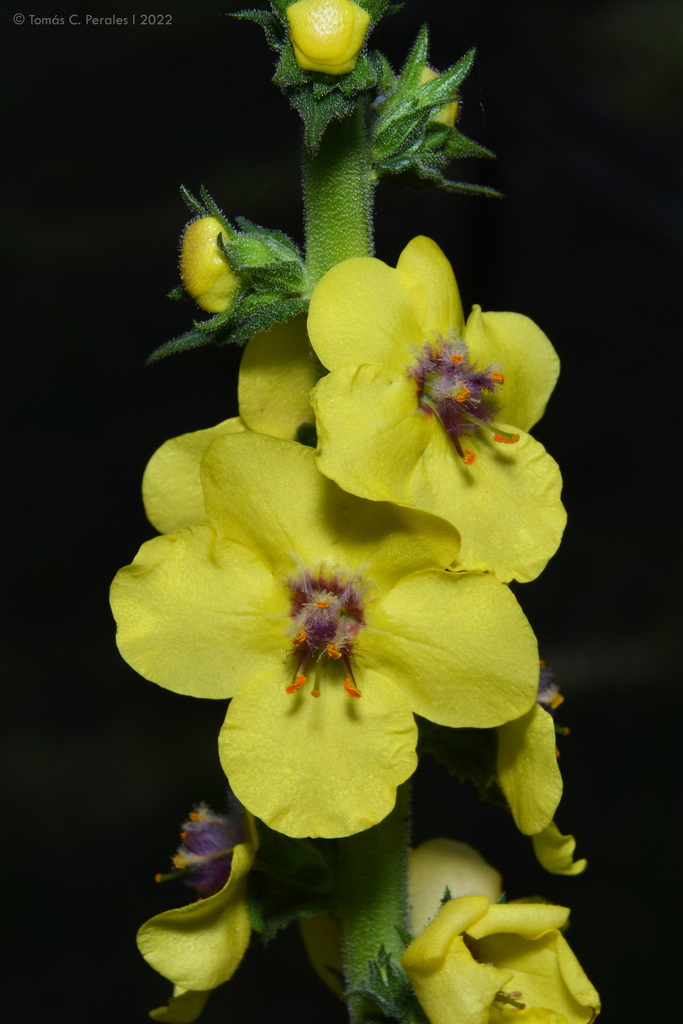
(c) Tomás Carranza Perales, some rights reserved (CC BY), uploaded by Tomás Carranza Perales · licence
Family: Scrophulariaceae · Type: Herb · Not Native
Verbascum virgatum (Wand mullein) is a non-native California herb in the Scrophulariaceae family.
Wand mullein is a naturalized annual found in northern coastal ranges, Sierra Nevada foothills, San Joaquin Valley, San Francisco Bay Area, southern coastal ranges, and southwestern California in streambanks, roadsides, disturbed grasslands, coastal sage scrub, chaparral, and oak woodland at elevations of 5 to 1,555 meters. Flowering from May to August, this plant produces bright yellow flowers 25 millimeters wide in open, glandular racemes with flowers clustered 1 to 4 per node. Growing 60 to 120 centimeters tall with stems branched just below the flowering structure, it has a distinctively bristly appearance with branched hairs. Its leaves range from basal obovate leaves 10 to 30 centimeters long with crenate edges to upper cauline leaves 7 to 15 centimeters long, lanceolate and cordate. The fruit is spherical, 7 to 8 millimeters long, and covered in glandular pubescence.
Identification and appearance
Key characters: Co-occurs with 4 species; key differentiator is bristly hairs, branched inflorescence, and open raceme with short pedicels
Habitat and range
Habitat: Streambanks, roadsides, disturbed grassland, coastal-sage scrub, chaparral, oak woodland
Elevation: 5-1555 m
California counties: Los Angeles, Ventura, Butte, Orange, Fresno, San Diego, Riverside, Sonoma, San Bernardino, Santa Barbara, Monterey, Calaveras, Placer, El Dorado, Amador, Tehama, Humboldt, San Mateo, Lassen, Yuba, Santa Cruz, San Luis Obispo, Napa
Outside California: native to Eurasia
Bloom period
Verbascum virgatum blooms May-Aug.
How to tell it apart
vs Stachys: Verbascum has nearly radial flowers in tall spikes; Stachys has bilateral flowers in whorled clusters.; vs Heterotheca: Verbascum has 5-petaled flowers with fuzzy stamens; Heterotheca has composite flower heads with ray and disk flowers.; vs Croton: Verbascum has showy yellow petaled flowers; Croton has tiny flowers without petals.; vs Oenothera: Verbascum has 5 stamens and fuzzy stalks; Oenothera has 8 stamens and smooth flower parts.; vs Dipsacus: Verbascum has individual flowers along spike; Dipsacus has flowers in dense, spiny, rounded heads.
Frequently asked questions
Is Verbascum virgatum native to California?
No. Verbascum virgatum is not native to California (recorded as not native).
When does Verbascum virgatum bloom?
Verbascum virgatum blooms May-Aug.
Where in California does Verbascum virgatum grow?
Verbascum virgatum occurs in Los Angeles, Ventura, Butte, Orange, Fresno, San Diego, Riverside, Sonoma and other counties, at elevations of 5-1555 m.
What plant family does Verbascum virgatum belong to?
Verbascum virgatum is in the Scrophulariaceae family, genus Verbascum.
What habitat does Verbascum virgatum grow in?
Verbascum virgatum grows in Streambanks, roadsides, disturbed grassland, coastal-sage scrub, chaparral, oak woodland.
Related species
Other California species in the same genus, family, or bioregion.
- Verbascum blattaria — Moth mullein
- Verbascum bombyciferum — Giant silver mullein
- Verbascum sp. — Mullein
- Verbascum speciosum — Showy mullein
- Verbascum thapsus — Woolly mullein
- Buddleja davidii — Butterfly bush
- Buddleja saligna — False olive
- Buddleja sp. — Butterfly bush
- Buddleja utahensis — Panamint butterfly bush
Sources: Jepson eFlora · Index of California Plant Names · CalPhotos
Last updated 2026-10-07
Data from The California Species Project — 14,000+ California species with verified data from CNPS, CDFW, USFWS, Cal-IPC, and more.