Verbena lasiostachys var. lasiostachys
Vervain
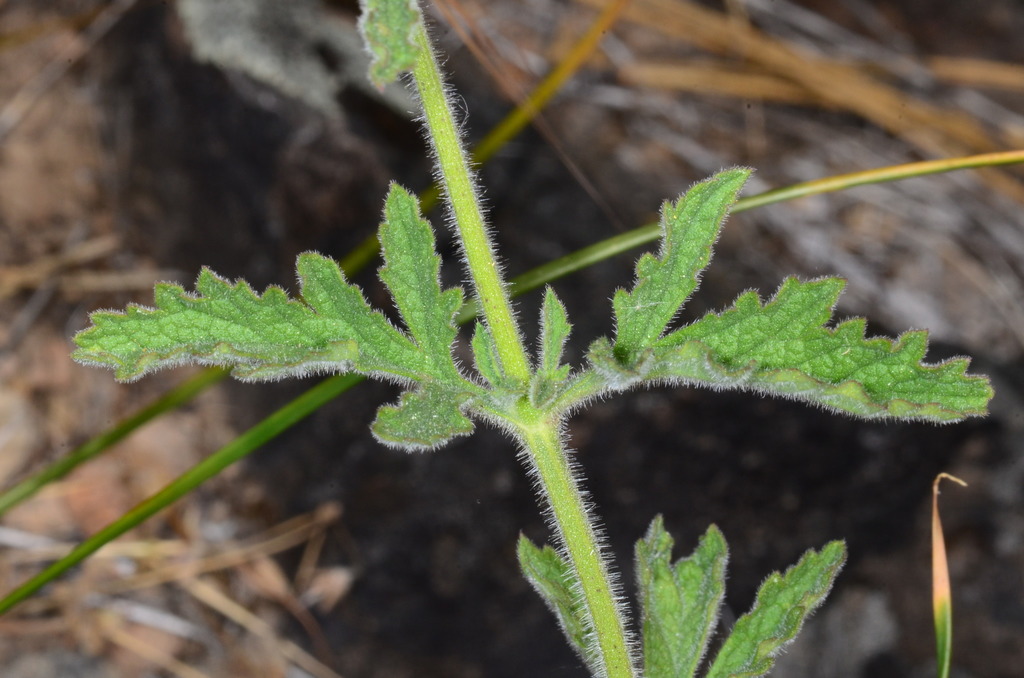
(c) Don Loarie, some rights reserved (CC BY) · licence
Family: Verbenaceae · Type: Perennial · Native
Verbena lasiostachys var. lasiostachys (Vervain) is a native California perennial in the Verbenaceae family, recognized by gray-green soft-hairy leaves vs. green stiff-hairy in var. scabrida.
Vervain is a California native perennial found in the California Floristic Province in open, dry to wet places at elevations below 2,500 meters. Flowering from May to September, this plant produces delicate purple to lavender flowers in slender, elongated clusters. Growing with upright stems 30 to 80 centimeters tall, it forms a robust and spreading clump. Its leaves are gray-green, softly hairy especially near the base, with a distinctive texture that feels slightly fuzzy to the touch. The small nutlets develop a brownish, slightly rough scar when mature.
Identification and appearance
Key characters: 9 sympatric species; key features are gray-green soft-hairy leaves vs. green stiff-hairy in var. scabrida
Habitat and range
Habitat: Open, dry to wet places
Elevation: < 2500 m
California counties: Santa Cruz, Orange, Siskiyou, San Mateo, Santa Clara, San Diego, Los Angeles, Mendocino, Monterey, Lake, Trinity, Fresno, Tuolumne, Sonoma, San Bernardino, Ventura, Santa Barbara, Shasta, Riverside, Contra Costa, Tehama, Nevada, Tulare, Kern, San Benito, San Luis Obispo, El Dorado, Amador, Madera, Colusa, Humboldt, Butte, Merced, Placer, Napa, Alameda, Mariposa, Del Norte
Outside California: Oregon
Bloom period
Verbena lasiostachys var. lasiostachys blooms May-Sep.
How to tell it apart
vs Glandularia: Verbena has nearly regular flowers; Glandularia has more obviously lobed flowers (often treated as same genus).; vs Phacelia: Verbena has tubular flowers with 5-toothed calyx; Phacelia has bowl-shaped flowers with coiled inflorescence.; vs Salvia: Verbena has nearly regular flowers; Salvia has distinctly two-lipped flowers with mint-family square stems.; vs Limonium: Verbena has tubular flowers producing nutlets; Limonium has papery flowers producing capsules.; vs Lavandula: Verbena has nearly regular small flowers; Lavandula has dense spikes of purple flowers with aromatic foliage.
Frequently asked questions
Is Verbena lasiostachys var. lasiostachys native to California?
Yes. Verbena lasiostachys var. lasiostachys is native to California (recorded as native).
When does Verbena lasiostachys var. lasiostachys bloom?
Verbena lasiostachys var. lasiostachys blooms May-Sep.
Where in California does Verbena lasiostachys var. lasiostachys grow?
Verbena lasiostachys var. lasiostachys occurs in Santa Cruz, Orange, Siskiyou, San Mateo, Santa Clara, San Diego, Los Angeles, Mendocino and other counties, at elevations of < 2500 m.
What plant family does Verbena lasiostachys var. lasiostachys belong to?
Verbena lasiostachys var. lasiostachys is in the Verbenaceae family, genus Verbena.
What habitat does Verbena lasiostachys var. lasiostachys grow in?
Verbena lasiostachys var. lasiostachys grows in Open, dry to wet places.
Related species
Other California species in the same genus, family, or bioregion.
Sources: Jepson eFlora · Index of California Plant Names · CalPhotos
Last updated 2026-10-06
Data from The California Species Project — 14,000+ California species with verified data from CNPS, CDFW, USFWS, Cal-IPC, and more.