Veronica americana
American brooklime
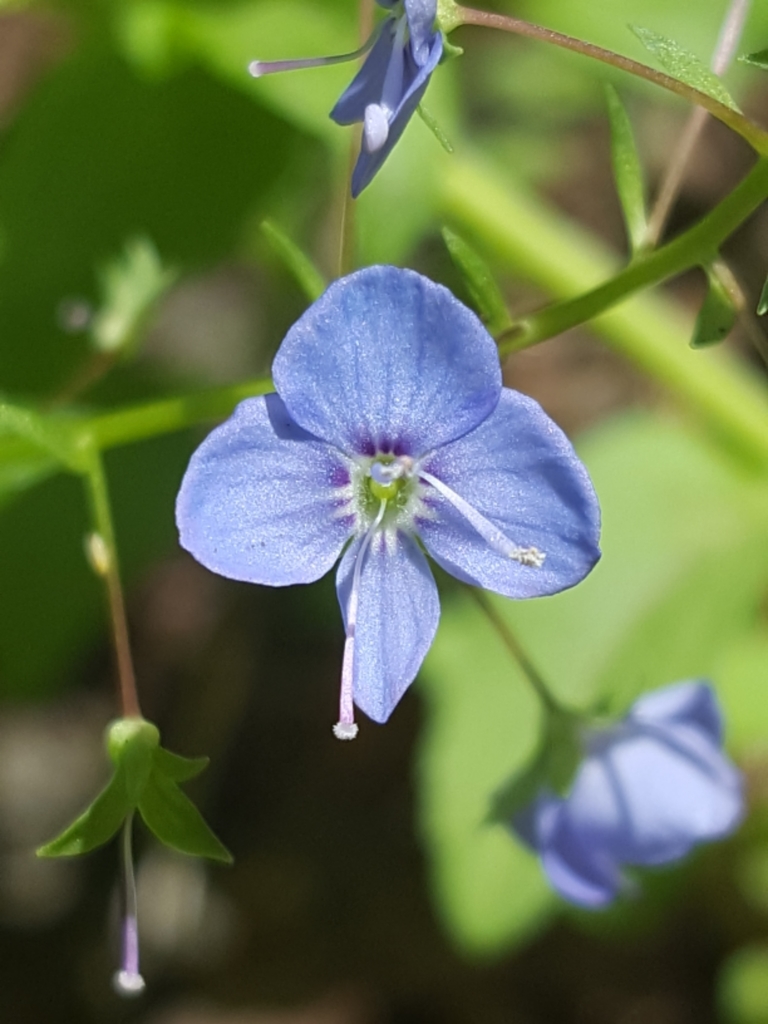
(c) Alex Abair, some rights reserved (CC BY), uploaded by Alex Abair · licence
Family: Plantaginaceae · Type: Herb · Native
Veronica americana (American brooklime) is a native California herb in the Plantaginaceae family, recognized by flower color, fruit shape, and leaf characteristics.
American brooklime is a California native perennial found in the California Floristic Province, Great Basin, and Desert Mountains in moist to wet habitats including springs, slow streams, meadows, and lakeshores at elevations up to 3,300 meters. Flowering from May to August, this plant produces violet-blue flowers with dark lines in small clusters, each blossom 7 to 10 millimeters long. Growing with decumbent stems 5 to 60 centimeters tall that root at lower nodes and branch freely, it spreads through underground rhizomes. Its leaves are lance-shaped to oval, 5 to 50 millimeters long with slightly serrated edges and pointed tips. The fruit is small and nearly round, about 3 to 4 millimeters in diameter.
Identification and appearance
Key characters: 10 sympatric species; key features are flower color, fruit shape, and leaf characteristics
Habitat and range
Habitat: Common. Moist to wet soil, springs, slow streams, meadows, lakeshores
Elevation: < 3300 m
California counties: Lake, Fresno, Kern, Alpine, Tulare, San Francisco, San Bernardino, Sonoma, Siskiyou, Riverside, Ventura, San Mateo, Trinity, Mendocino, Tehama, Madera, Mono, Lassen, Humboldt, Marin, Inyo, Monterey, Tuolumne, Alameda, Mariposa, Plumas, Modoc, Shasta, Butte, Napa, Placer, Del Norte, Glenn, Los Angeles, Santa Clara, San Luis Obispo, Sierra, El Dorado, Calaveras, Yuba, Nevada, Contra Costa, Santa Cruz, Colusa, Santa Barbara, Stanislaus, San Joaquin, Amador
Outside California: United States, Canada, temperate & arctic Asia
Bloom period
Veronica americana blooms May-Aug.
How to tell it apart
vs Melaleuca: Melaleuca has bottlebrush flowers with numerous stamens; Veronica has simple four-petaled flowers with 2 stamens.; vs Nemophila: Nemophila has bowl-shaped flowers with leaves cut into lobes; Veronica has flat flowers and unlobed leaves.; vs Monardella: Monardella has flowers in dense heads with minty aroma; Veronica has scattered four-petaled flowers, no scent.; vs Ludwigia: Ludwigia has bright yellow four-petaled flowers; Veronica has blue, white, or pink flowers in racemes.; vs Lysimachia: Lysimachia has five petals and five sepals; Veronica has four petals and four sepals.
Frequently asked questions
Is Veronica americana native to California?
Yes. Veronica americana is native to California (recorded as native).
When does Veronica americana bloom?
Veronica americana blooms May-Aug.
Where in California does Veronica americana grow?
Veronica americana occurs in Lake, Fresno, Kern, Alpine, Tulare, San Francisco, San Bernardino, Sonoma and other counties, at elevations of < 3300 m.
What plant family does Veronica americana belong to?
Veronica americana is in the Plantaginaceae family, genus Veronica.
What habitat does Veronica americana grow in?
Veronica americana grows in Common. Moist to wet soil, springs, slow streams, meadows, lakeshores.
Related species
Other California species in the same genus, family, or bioregion.
Sources: Jepson eFlora · Index of California Plant Names · CalPhotos
Last updated 2026-10-07
Data from The California Species Project — 14,000+ California species with verified data from CNPS, CDFW, USFWS, Cal-IPC, and more.