Veronica arvensis
Corn speedwell
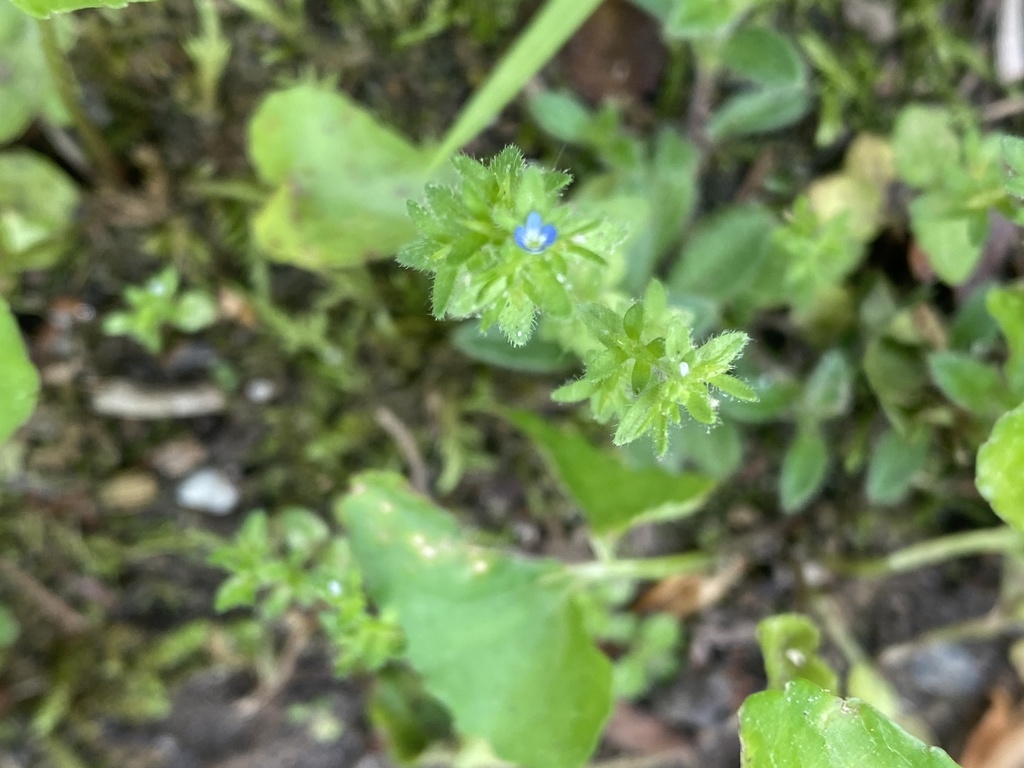
(c) Judy Gallagher, some rights reserved (CC BY-SA) · licence
Family: Plantaginaceae · Type: Herb · Not Native
Veronica arvensis (Corn speedwell) is a non-native California herb in the Plantaginaceae family, recognized by small flower size, leaf shape, and fruit characteristics.
Corn speedwell is a naturalized annual found in the Klamath Ranges, northern coastal California, Sierra Nevada foothills, Central Valley, San Francisco Bay Area, southern coastal ranges, Transverse Ranges, Peninsular Ranges, Modoc Plateau, and desert regions in meadow habitats at elevations below 1,500 meters. Flowering from April to July, this plant produces blue to violet flowers in small racemes with delicate petals around 2 to 3 millimeters long. Growing with prostrate to erect stems 5 to 40 centimeters tall, it spreads in branching clusters with fibrous roots. Its leaves are triangular to ovate, 2 to 15 millimeters long, with crenate or serrate edges and bases ranging from cordate to truncate. The fruit is flat and ciliate, measuring 3 to 4 millimeters with a small notch, containing multiple tiny smooth seeds.
Identification and appearance
Key characters: 9 sympatric species; key features are small flower size, leaf shape, and fruit characteristics
Habitat and range
Habitat: Meadows
Elevation: < 1500 m
California counties: Lassen, Tulare, Calaveras, Alameda, San Diego, El Dorado, Monterey, Fresno, Los Angeles, Riverside, Orange, San Bernardino, Trinity, San Francisco, Lake, Santa Clara, Humboldt, Santa Barbara, San Luis Obispo, Placer, Sonoma, Sacramento, Shasta, Merced, Butte, Mendocino, Tehama, Yuba, Modoc, Ventura, Napa, Madera, Kern, Santa Cruz, Plumas, Del Norte, San Mateo, Mariposa, Yolo, Stanislaus
Outside California: widely naturalized, native to Eurasia
Bloom period
Veronica arvensis blooms Apr-Jul.
How to tell it apart
vs Melaleuca: Melaleuca has bottlebrush flowers with numerous stamens; Veronica has simple four-petaled flowers with 2 stamens.; vs Nemophila: Nemophila has bowl-shaped flowers with leaves cut into lobes; Veronica has flat flowers and unlobed leaves.; vs Monardella: Monardella has flowers in dense heads with minty aroma; Veronica has scattered four-petaled flowers, no scent.; vs Ludwigia: Ludwigia has bright yellow four-petaled flowers; Veronica has blue, white, or pink flowers in racemes.; vs Lysimachia: Lysimachia has five petals and five sepals; Veronica has four petals and four sepals.
Frequently asked questions
Is Veronica arvensis native to California?
No. Veronica arvensis is not native to California (recorded as not native).
When does Veronica arvensis bloom?
Veronica arvensis blooms Apr-Jul.
Where in California does Veronica arvensis grow?
Veronica arvensis occurs in Lassen, Tulare, Calaveras, Alameda, San Diego, El Dorado, Monterey, Fresno and other counties, at elevations of < 1500 m.
What plant family does Veronica arvensis belong to?
Veronica arvensis is in the Plantaginaceae family, genus Veronica.
What habitat does Veronica arvensis grow in?
Veronica arvensis grows in Meadows.
Related species
Other California species in the same genus, family, or bioregion.
Sources: Jepson eFlora · Index of California Plant Names · CalPhotos
Last updated 2026-10-07
Data from The California Species Project — 14,000+ California species with verified data from CNPS, CDFW, USFWS, Cal-IPC, and more.