Veronica copelandii
Copeland's speedwell
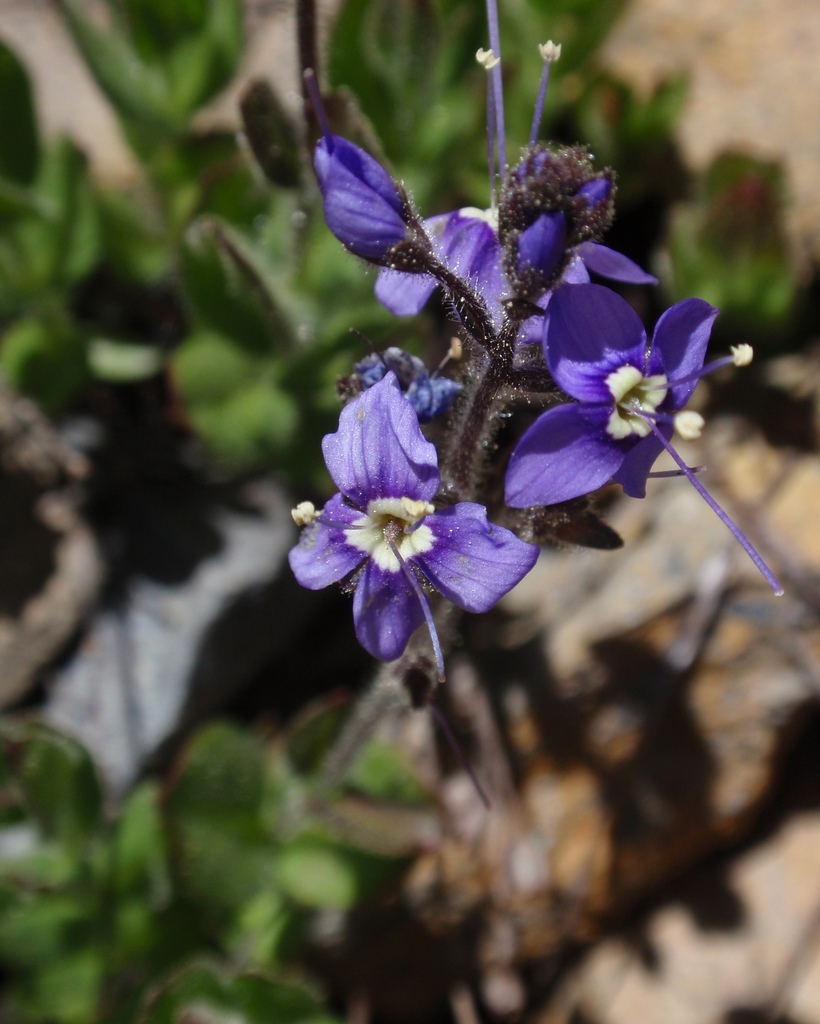
(c) Tom Hilton, some rights reserved (CC BY) · licence
Family: Plantaginaceae · Type: Herb · Native
Conservation status: CNPS 4.3
Veronica copelandii (Copeland's speedwell) is a native California herb in the Plantaginaceae family, recognized by distinctive hairiness and long style are key features.
Copeland's speedwell is a California native perennial found in the eastern Klamath Ranges, specifically in Trinity and Siskiyou counties, inhabiting subalpine meadows and slopes at elevations below 2,600 meters. Flowering in August, this plant produces pale blue to lavender-rose flowers 8 to 10 millimeters long in terminal racemes with delicate pedicels. Growing with ascending, branched stems 5 to 12 centimeters tall, it forms a rhizomatous base with shaggy, glandular hairs. Its leaves are sessile, oblong to elliptic, 5 to 35 millimeters long, with entire margins and a hairy texture, positioned acutely or obtusely at the stem. The fruit is slightly longer than wide, with a barely perceptible notch at the tip.
Identification and appearance
Key characters: 8 sympatric species; distinctive hairiness and long style are key features
Habitat and range
Habitat: Subalpine meadows, slopes
Elevation: < 2600 m
California counties: Trinity, Siskiyou, Tuolumne
Bloom period
Veronica copelandii blooms Aug.
Conservation status
CNPS 4.3
How to tell it apart
vs Melaleuca: Melaleuca has bottlebrush flowers with numerous stamens; Veronica has simple four-petaled flowers with 2 stamens.; vs Nemophila: Nemophila has bowl-shaped flowers with leaves cut into lobes; Veronica has flat flowers and unlobed leaves.; vs Monardella: Monardella has flowers in dense heads with minty aroma; Veronica has scattered four-petaled flowers, no scent.; vs Ludwigia: Ludwigia has bright yellow four-petaled flowers; Veronica has blue, white, or pink flowers in racemes.; vs Lysimachia: Lysimachia has five petals and five sepals; Veronica has four petals and four sepals.
Frequently asked questions
Is Veronica copelandii native to California?
Yes. Veronica copelandii is native to California (recorded as native).
When does Veronica copelandii bloom?
Veronica copelandii blooms Aug.
Where in California does Veronica copelandii grow?
Veronica copelandii occurs in Trinity, Siskiyou, Tuolumne, at elevations of < 2600 m.
What plant family does Veronica copelandii belong to?
Veronica copelandii is in the Plantaginaceae family, genus Veronica.
Is Veronica copelandii rare or endangered?
Veronica copelandii carries California Rare Plant Rank 4.3, state rank S3.
Related species
Other California species in the same genus, family, or bioregion.
Sources: Jepson eFlora · CNPS Rare Plant Inventory · Index of California Plant Names · CalPhotos · CDFW CNDDB
Last updated 2026-10-07
Data from The California Species Project — 14,000+ California species with verified data from CNPS, CDFW, USFWS, Cal-IPC, and more.