Veronica serpyllifolia subsp. humifusa
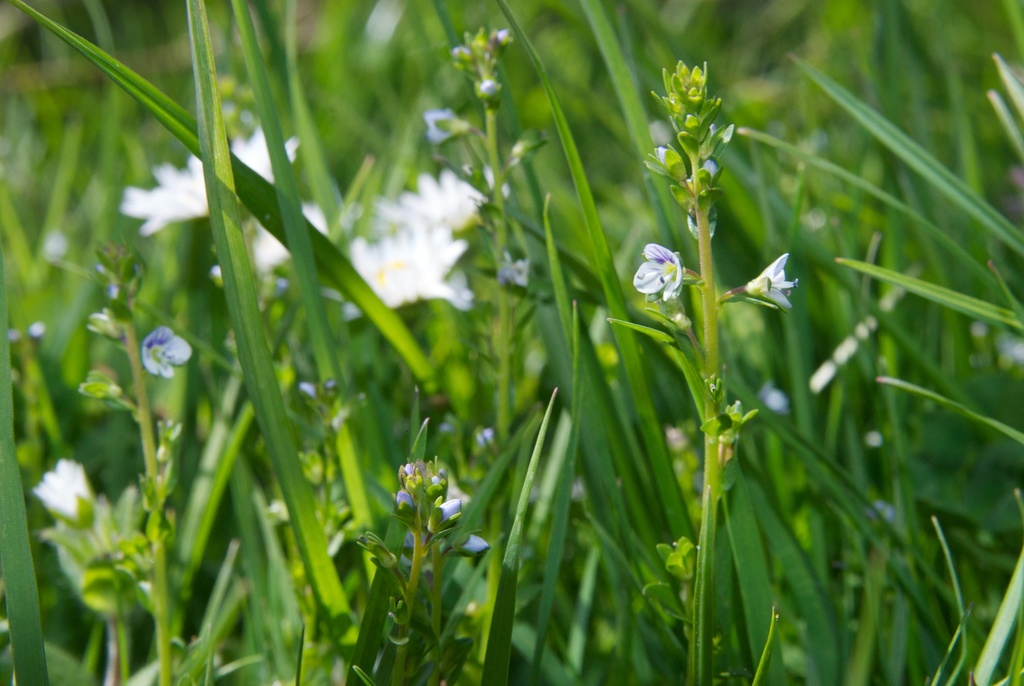
(c) Jon Sullivan, some rights reserved (CC BY) · licence
Family: Plantaginaceae · Type: Herb · Native
Veronica serpyllifolia subsp. humifusa is a native California herb in the Plantaginaceae family, recognized by decumbent growth form and bright blue flowers are key.
Thyme-leaved speedwell is a California native perennial found in northwestern California, Cascade Range, Sierra Nevada, central coastal California, San Francisco Bay Area, San Bernardino Mountains, and eastern Sierra Nevada in moist streambanks, lakeshores, and meadows at elevations below 3,200 meters. Flowering from April to August, this plant produces bright blue flowers about 6 to 7 millimeters wide in terminal racemes. Growing with decumbent stems 5 to 30 centimeters tall that are slightly hairy and erect only at the tips, it spreads through rhizomes. Its leaves are 10 to 25 millimeters long, elliptic to widely ovate, with entire or slightly crenate edges and obtuse tips. The small fruit is 2.8 to 3.7 millimeters wide, slightly wider than long and glandular-hairy.
Identification and appearance
Key characters: 10 sympatric species; decumbent growth form and bright blue flowers are key
Habitat and range
Habitat: Moist streambanks, lakeshores, meadows
Elevation: < 3200 m
California counties: Fresno, Plumas, Tulare, San Bernardino, Madera, Mono, Riverside, Butte, Mariposa, Humboldt, Inyo, Kern, Sierra, Siskiyou, El Dorado, Lake, Amador, Nevada, Modoc, Placer, Lassen, Mendocino, Tehama, Glenn, Alpine, Shasta, Colusa, Del Norte, Marin, Alameda, Santa Cruz, Tuolumne, Trinity, Santa Clara, San Francisco, Stanislaus, Yolo
Outside California: to Alaska, northeastern United States, New Mexico, also in South America, Eurasia
Bloom period
Veronica serpyllifolia subsp. humifusa blooms Apr-Aug.
How to tell it apart
vs Melaleuca: Melaleuca has bottlebrush flowers with numerous stamens; Veronica has simple four-petaled flowers with 2 stamens.; vs Nemophila: Nemophila has bowl-shaped flowers with leaves cut into lobes; Veronica has flat flowers and unlobed leaves.; vs Monardella: Monardella has flowers in dense heads with minty aroma; Veronica has scattered four-petaled flowers, no scent.; vs Ludwigia: Ludwigia has bright yellow four-petaled flowers; Veronica has blue, white, or pink flowers in racemes.; vs Lysimachia: Lysimachia has five petals and five sepals; Veronica has four petals and four sepals.
Frequently asked questions
Is Veronica serpyllifolia subsp. humifusa native to California?
Yes. Veronica serpyllifolia subsp. humifusa is native to California (recorded as native).
When does Veronica serpyllifolia subsp. humifusa bloom?
Veronica serpyllifolia subsp. humifusa blooms Apr-Aug.
Where in California does Veronica serpyllifolia subsp. humifusa grow?
Veronica serpyllifolia subsp. humifusa occurs in Fresno, Plumas, Tulare, San Bernardino, Madera, Mono, Riverside, Butte and other counties, at elevations of < 3200 m.
What plant family does Veronica serpyllifolia subsp. humifusa belong to?
Veronica serpyllifolia subsp. humifusa is in the Plantaginaceae family, genus Veronica.
What habitat does Veronica serpyllifolia subsp. humifusa grow in?
Veronica serpyllifolia subsp. humifusa grows in Moist streambanks, lakeshores, meadows.
Related species
Other California species in the same genus, family, or bioregion.
Sources: Jepson eFlora · Index of California Plant Names · CalPhotos
Last updated 2026-10-07
Data from The California Species Project — 14,000+ California species with verified data from CNPS, CDFW, USFWS, Cal-IPC, and more.