Vicia villosa subsp. varia
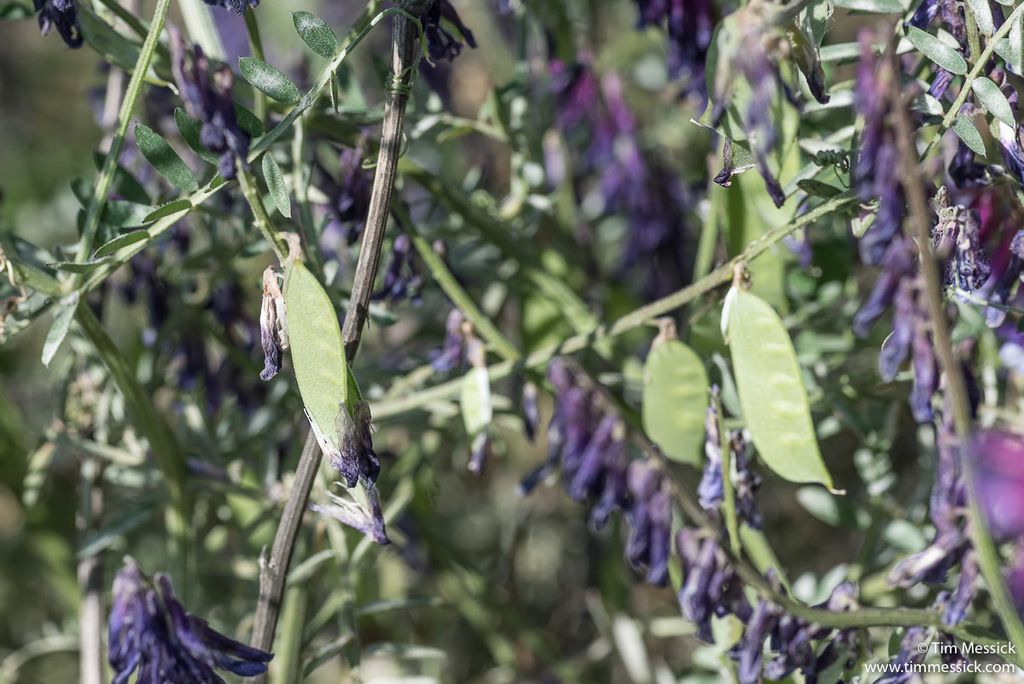
(c) Tim Messick, some rights reserved (CC BY), uploaded by Tim Messick · licence
Family: Fabaceae · Type: Vine · Not Native
Vicia villosa subsp. varia is a non-native California vine in the Fabaceae family, recognized by subsp. villosa by sparser hairs and smaller flowers.
Hairy vetch is a naturalized annual found in northern California coastal ranges, Sacramento Valley, central western California, Transverse Ranges, and Peninsular Ranges in grasslands, roadsides, and disturbed areas at elevations below 1,200 meters. Flowering from March to June, this plant produces purple to blue flowers in clusters of 10 to 20 blooms. Growing with slender climbing stems that are sparsely covered in short appressed hairs, it reaches heights typical of annual legumes. Its compound leaves have narrow lanceolate stipules and multiple leaflets, characteristic of vetch species. The plant produces sparse, short-haired seed pods typical of its genus.
Identification and appearance
Key characters: 17 sympatric species; distinguished from subsp. villosa by sparser hairs and smaller flowers
Habitat and range
Habitat: Grassland, roadside, disturbed areas
Elevation: < 1200(2072) m
California counties: El Dorado, Orange, Los Angeles, San Bernardino, Riverside, Butte, Santa Barbara, San Luis Obispo, Mendocino, Monterey, San Diego, Placer, Amador, Sutter, Colusa, Solano, Calaveras, Yuba, Sacramento, Contra Costa, Yolo, Napa, Tehama, Shasta, Glenn, Merced, Alameda, Stanislaus, Santa Cruz, Mono, Marin, Santa Clara, San Mateo, Sonoma, Trinity, Del Norte, Humboldt, San Benito, Ventura, Fresno, Nevada, San Joaquin, Lake
Outside California: introduced in United States, native to Europe
Bloom period
Vicia villosa subsp. varia blooms Mar-Jun.
How to tell it apart
vs Lathyrus: Vicia style is round and hairy all around; Lathyrus style is flattened with hairs only on top.; vs Astragalus: Vicia has tendrils at leaf tips; Astragalus leaves end in a leaflet with no tendril.; vs Pisum: Vicia has many leaflets and tiny stipules; Pisum has 4-6 leaflets and giant stipules.; vs Salvia: Vicia has pea flowers and tendril-tipped leaves; Salvia has tubular two-lipped flowers and simple leaves.; vs Lupinus: Vicia has tendril-tipped pinnate leaves; Lupinus has palmate leaves radiating from one point.
Frequently asked questions
Is Vicia villosa subsp. varia native to California?
No. Vicia villosa subsp. varia is not native to California (recorded as not native).
When does Vicia villosa subsp. varia bloom?
Vicia villosa subsp. varia blooms Mar-Jun.
Where in California does Vicia villosa subsp. varia grow?
Vicia villosa subsp. varia occurs in El Dorado, Orange, Los Angeles, San Bernardino, Riverside, Butte, Santa Barbara, San Luis Obispo and other counties, at elevations of < 1200(2072) m.
What plant family does Vicia villosa subsp. varia belong to?
Vicia villosa subsp. varia is in the Fabaceae family, genus Vicia.
What habitat does Vicia villosa subsp. varia grow in?
Vicia villosa subsp. varia grows in Grassland, roadside, disturbed areas.
Related species
Other California species in the same genus, family, or bioregion.
- Vicia villosa subsp. villosa
- Vicia americana subsp. americana — American vetch
- Vicia benghalensis — Purple vetch
- Vicia bithynica — Bithynian vetch
- Vicia cracca — Bird vetch
- Vicia disperma — Two-seeded vetch
- Acacia baileyana — Cootamundra wattle
- Acacia cyclops — Western coastal wattle
- Acacia dealbata — Silver wattle
Sources: Jepson eFlora · Index of California Plant Names · CalPhotos
Last updated 2026-10-07
Data from The California Species Project — 14,000+ California species with verified data from CNPS, CDFW, USFWS, Cal-IPC, and more.