Vicia villosa subsp. villosa
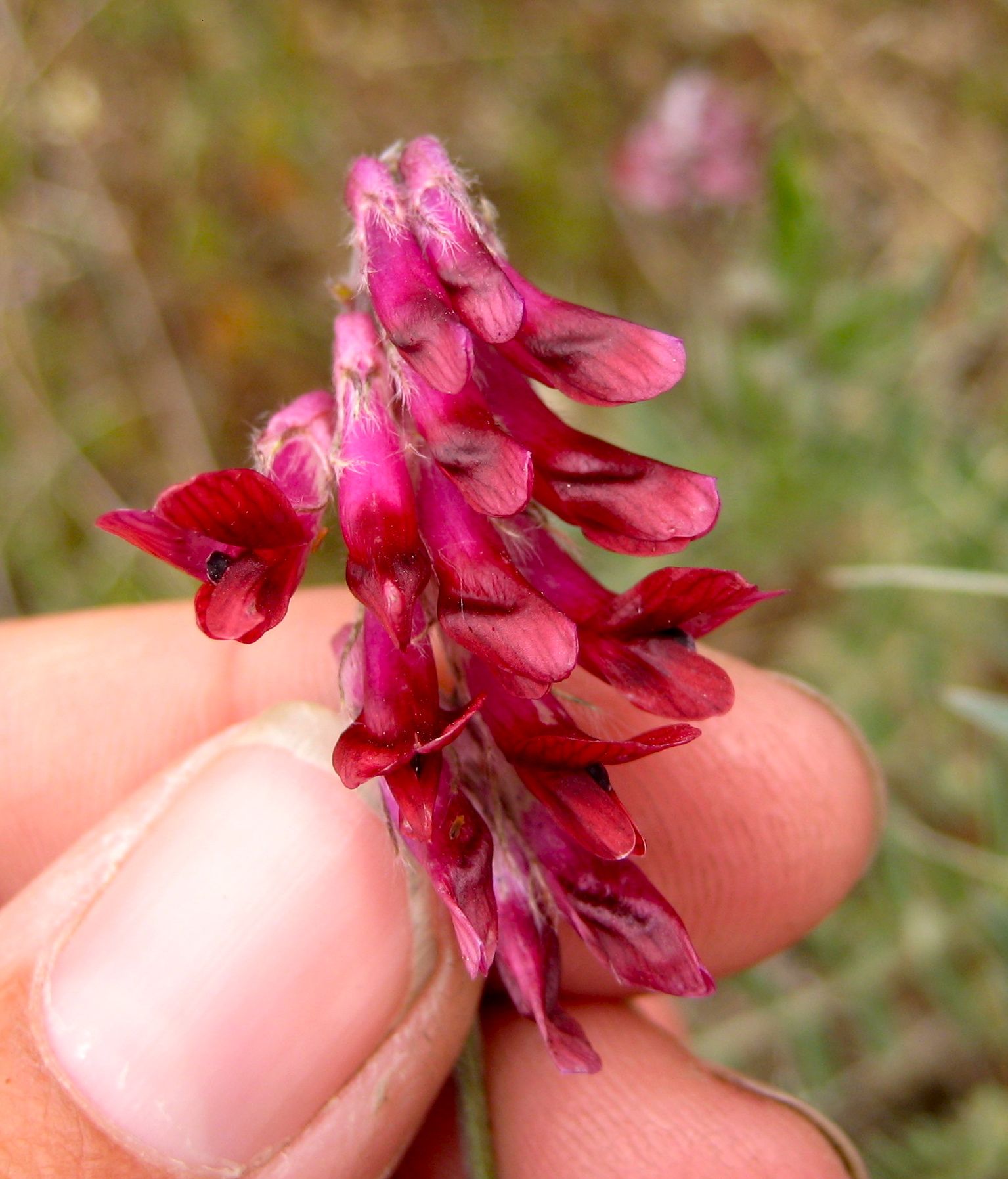
Photo: parent species Vicia villosa · Photo by Chez Brungraber
Family: Fabaceae · Type: Vine · Not Native
Vicia villosa subsp. villosa is a non-native California vine in the Fabaceae family, recognized by dense spreading hairs and larger flower clusters.
Hairy vetch is a naturalized annual found in grasslands, roadsides, and disturbed areas across northern California coastal regions, central Sierra Nevada foothills, Central Valley, coastal areas, Channel Islands, and Great Basin at elevations to 2,090 meters. Flowering from May to July, this plant produces purple to blue flowers in dense clusters with 19 or more blooms, each flower 14 to 18 millimeters long. Growing with spreading stems 30 to 60 centimeters tall, the plant is characterized by conspicuous, spreading hairs 1 to 2 millimeters long on upper stems. Its compound leaves feature widely lanceolate stipules and multiple leaflets, with each leaf having soft hairs contributing to the plant's distinctive texture. The plant produces smooth, glabrous seed pods that develop after flowering.
Identification and appearance
Key characters: 16 sympatric species; distinguished by dense spreading hairs and larger flower clusters
Habitat and range
Habitat: Grassland, roadside, disturbed areas
Elevation: < 2090 m
California counties: Alpine, Sonoma, Los Angeles, San Bernardino, San Diego, Kern, Nevada, San Luis Obispo, Santa Barbara, Riverside, Amador, El Dorado, Calaveras, Sutter, Placer, Solano, Sacramento, Butte, San Joaquin, Stanislaus, Contra Costa, Yolo, Trinity, Siskiyou, Colusa, Lassen, Humboldt, Santa Cruz, Mono, Alameda, Napa, Tuolumne, Modoc, Fresno, Ventura, Mendocino, Monterey, Lake, Orange
Outside California: introduced, cultivated in western and southern United States, native to Europe
Bloom period
Vicia villosa subsp. villosa blooms May-Jul.
How to tell it apart
vs Lathyrus: Vicia style is round and hairy all around; Lathyrus style is flattened with hairs only on top.; vs Astragalus: Vicia has tendrils at leaf tips; Astragalus leaves end in a leaflet with no tendril.; vs Pisum: Vicia has many leaflets and tiny stipules; Pisum has 4-6 leaflets and giant stipules.; vs Salvia: Vicia has pea flowers and tendril-tipped leaves; Salvia has tubular two-lipped flowers and simple leaves.; vs Lupinus: Vicia has tendril-tipped pinnate leaves; Lupinus has palmate leaves radiating from one point.
Frequently asked questions
Is Vicia villosa subsp. villosa native to California?
No. Vicia villosa subsp. villosa is not native to California (recorded as not native).
When does Vicia villosa subsp. villosa bloom?
Vicia villosa subsp. villosa blooms May-Jul.
Where in California does Vicia villosa subsp. villosa grow?
Vicia villosa subsp. villosa occurs in Alpine, Sonoma, Los Angeles, San Bernardino, San Diego, Kern, Nevada, San Luis Obispo and other counties, at elevations of < 2090 m.
What plant family does Vicia villosa subsp. villosa belong to?
Vicia villosa subsp. villosa is in the Fabaceae family, genus Vicia.
What habitat does Vicia villosa subsp. villosa grow in?
Vicia villosa subsp. villosa grows in Grassland, roadside, disturbed areas.
Related species
Other California species in the same genus, family, or bioregion.
- Vicia americana subsp. americana — American vetch
- Vicia benghalensis — Purple vetch
- Vicia bithynica — Bithynian vetch
- Vicia cracca — Bird vetch
- Vicia disperma — Two-seeded vetch
- Vicia faba — Fava bean
- Acacia baileyana — Cootamundra wattle
- Acacia cyclops — Western coastal wattle
- Acacia dealbata — Silver wattle
- Acacia decurrens — Green wattle
Sources: Jepson eFlora · Index of California Plant Names · CalPhotos
Last updated 2026-10-07
Data from The California Species Project — 14,000+ California species with verified data from CNPS, CDFW, USFWS, Cal-IPC, and more.