Vinca major
Greater periwinkle, Greater Periwinkle
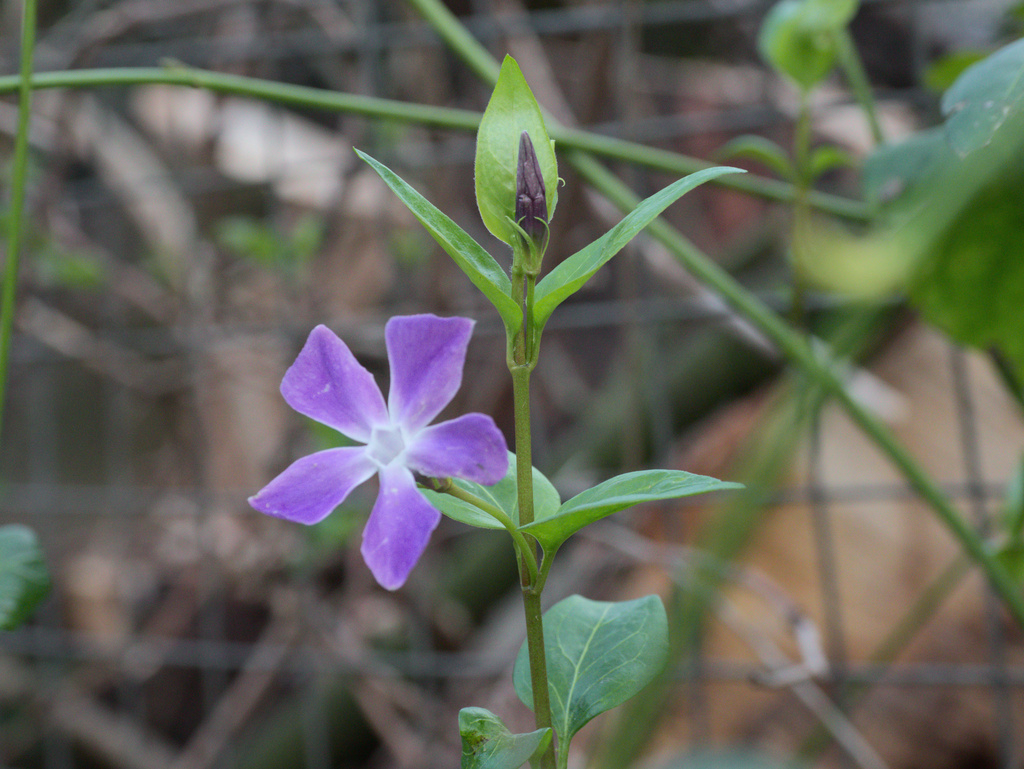
(c) Daniel Cahen, some rights reserved (CC BY) · licence
Family: Apocynaceae · Type: Vine · Not Native
Conservation status: Cal-IPC Yes
Vinca major (Greater periwinkle) is a non-native California vine in the Apocynaceae family, recognized by European ornamental introduction, only Vinca species established in California.
Greater periwinkle is a naturalized perennial found in coastal bluffs, stream beds, and sheltered places across northern California coastal regions, central California valleys, and southern California mountain ranges at elevations of 2 to 1,600 meters. Flowering from January to June, this plant produces distinctive purple-blue (occasionally white) flowers 3 to 5 centimeters wide, creating striking visual displays. Growing with sprawling, arching stems that root at their tips, it can form dense ground-covering patches 7 centimeters tall. Its leaves are ovate with truncate bases and acute tips, typically around 7 centimeters long with petioles less than 1 centimeter. Rarely producing curved fruits, the greater periwinkle is primarily known for its ability to spread and naturalize in diverse California landscapes.
Identification and appearance
Key characters: European ornamental introduction, only Vinca species established in California
Habitat and range
Habitat: Coastal bluffs, sheltered places, especially along stream beds
Elevation: 2-1600 m
California counties: San Diego, Ventura, Santa Clara, Sonoma, San Bernardino, San Mateo, Riverside, Los Angeles, Orange, Butte, Del Norte, Santa Barbara, Placer, San Francisco, Santa Cruz, Solano, Contra Costa, Mendocino, San Luis Obispo, Nevada, Napa, El Dorado, Marin, Humboldt, Fresno, Alameda, Siskiyou, Yuba, Sacramento, Merced, Stanislaus, Lake, Yolo, Kern, Tulare, Monterey
Outside California: southern United States, native probably to Europe
Bloom period
Vinca major blooms Mar-Jun(Jan).
Conservation status
Cal-IPC Yes
How to tell it apart
vs Catharanthus: Vinca has asymmetric pinwheel petals and trailing stems; Catharanthus has symmetric flat-faced flowers and upright bushy growth.; vs Lonicera: Vinca has five separate flat petals in a pinwheel; Lonicera has tubular flowers with upper and lower lips.; vs Trachelospermum: Vinca has blue-purple flowers and trails on ground; Trachelospermum has white star-shaped flowers and climbs vigorously.; vs Hedera: Vinca has showy blue-purple flowers; Hedera has tiny greenish flowers in rounded clusters.; vs Brunfelsia: Vinca trails flat on ground with small leaves; Brunfelsia grows as upright shrub with much larger flowers.
Frequently asked questions
Is Vinca major native to California?
No. Vinca major is not native to California (recorded as not native).
When does Vinca major bloom?
Vinca major blooms Mar-Jun(Jan).
Where in California does Vinca major grow?
Vinca major occurs in San Diego, Ventura, Santa Clara, Sonoma, San Bernardino, San Mateo, Riverside, Los Angeles and other counties, at elevations of 2-1600 m.
What plant family does Vinca major belong to?
Vinca major is in the Apocynaceae family, genus Vinca.
Is Vinca major invasive in California?
Vinca major is listed by Cal-IPC with an invasiveness rating of Yes.
Related species
Other California species in the same genus, family, or bioregion.
Sources: Jepson eFlora · Index of California Plant Names · CalPhotos
Last updated 2026-10-07
Data from The California Species Project — 14,000+ California species with verified data from CNPS, CDFW, USFWS, Cal-IPC, and more.