Viola cuneata
Northern two-eyed violet, wedge-leaved violet, Wedge-Leaved Violet
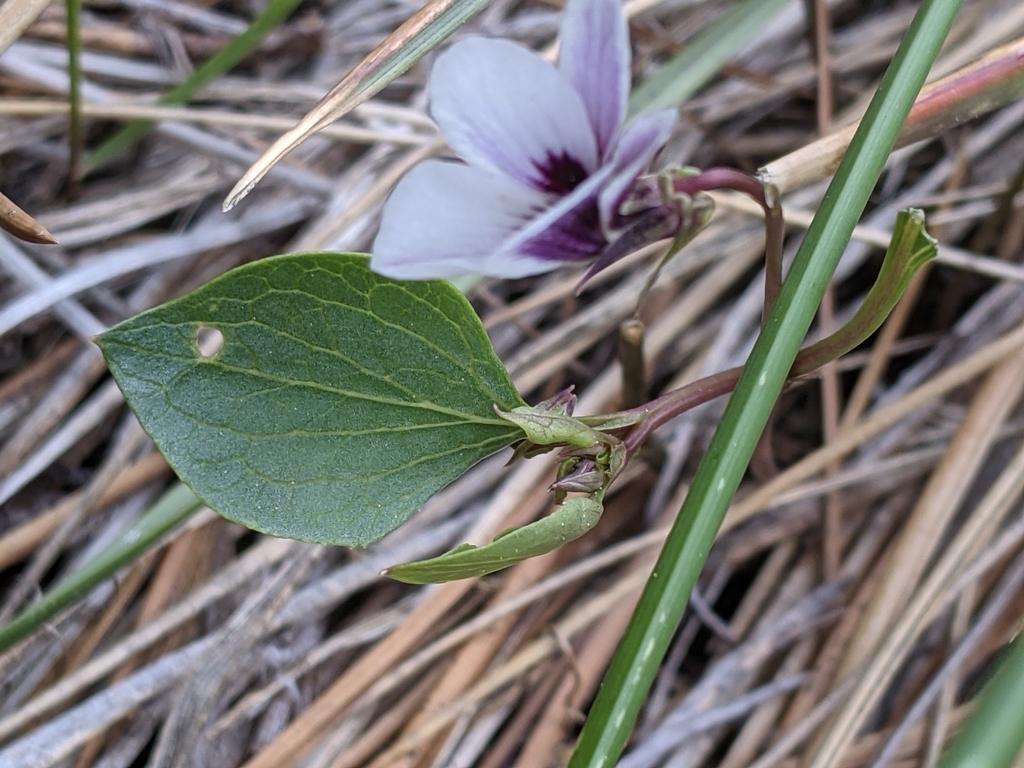
(c) David Anderson, some rights reserved (CC BY) · licence
Family: Violaceae · Type: Herb · Native
Viola cuneata (Northern two-eyed violet) is a native California herb in the Violaceae family, recognized by . Key features: bicolored flowers, purple-spotted petals, wedge-based leaves.
Northern two-eyed violet is a California native perennial found in northwestern California and the northern Sierra Nevada Mountains in vernally moist areas of open pine or oak forests, often on serpentine, at elevations of 120 to 2,200 meters. Flowering from March to September, this plant produces white petals with deep red-violet undersides and distinctive yellow and purple basal markings on its delicate flowers. Growing with prostrate to erect stems 2 to 25 centimeters tall emerging from thin, shallow rhizomes, it develops glossy, leathery leaves with purple-veined surfaces. Its leaves are round-ovate to deltate, mostly 1 to 4 centimeters long with wedge-shaped bases and slightly serrated edges, featuring basal leaves that are particularly shiny. The plant produces small round fruits 5 to 9 millimeters long, which contain deep brown-purple seeds.
Identification and appearance
Key characters: 32 sympatric species. Key features: bicolored flowers, purple-spotted petals, wedge-based leaves
Habitat and range
Habitat: Uncommon. Vernally moist areas in open pine or oak forests, often on serpentine
Elevation: 120-2200 m
California counties: Mendocino, Trinity, Humboldt, Del Norte, Siskiyou, Marin, Nevada, Mariposa, Tehama, Shasta, Butte
Outside California: southwestern Oregon
Bloom period
Viola cuneata blooms Mar-Sep.
How to tell it apart
vs Asarum: Viola flowers sit above ground on stalks; Asarum flowers hide at ground level under heart-shaped leaves.; vs Cardamine: Viola has irregular flowers with a spur; Cardamine has 4-petaled symmetrical flowers.; vs Lycianthes: Viola flowers have a backward spur; Lycianthes has star-shaped flowers with no spur.; vs Pelargonium: Viola has a petal-derived spur; Pelargonium has a sepal-derived spur fused to the flower stalk.; vs Eschscholzia: Viola has 5 petals with one forming a spur; Eschscholzia has 4 separate fan-shaped petals.
Frequently asked questions
Is Viola cuneata native to California?
Yes. Viola cuneata is native to California (recorded as native).
When does Viola cuneata bloom?
Viola cuneata blooms Mar-Sep.
Where in California does Viola cuneata grow?
Viola cuneata occurs in Mendocino, Trinity, Humboldt, Del Norte, Siskiyou, Marin, Nevada, Mariposa and other counties, at elevations of 120-2200 m.
What plant family does Viola cuneata belong to?
Viola cuneata is in the Violaceae family, genus Viola.
What habitat does Viola cuneata grow in?
Viola cuneata grows in Uncommon. Vernally moist areas in open pine or oak forests, often on serpentine.
Related species
Other California species in the same genus, family, or bioregion.
Sources: Jepson eFlora · Index of California Plant Names · CalPhotos
Last updated 2026-10-07
Data from The California Species Project — 14,000+ California species with verified data from CNPS, CDFW, USFWS, Cal-IPC, and more.