Viola lobata subsp. lobata
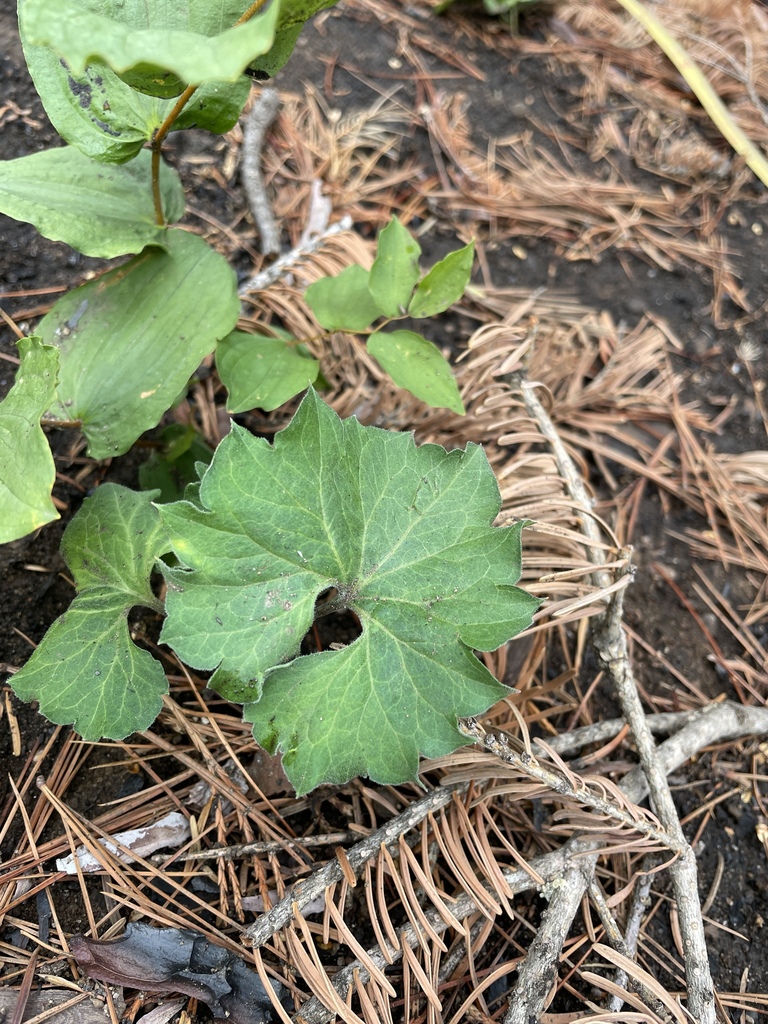
Photo: parent species Viola lobata · (c) Max Miley, some rights reserved (CC BY) · licence
Family: Violaceae · Type: Herb · Native
Viola lobata subsp. lobata is a native California herb in the Violaceae family, recognized by . Key features: yellow flowers, leaves wider than long, deeply lobed/dissected.
Stream violet is a California native perennial found in northwestern California, the Cascade Range, Sierra Nevada, Peninsular Ranges in dry shady or open places in chaparral, oak woodland, and mixed-conifer forests at elevations of 45 to 2,300 meters. Flowering from April to August, this plant produces flowers in shades of white, blue, or purple with distinctive lobed petals. Growing with stems 10 to 30 centimeters tall, it forms low-spreading clumps in forest understories. Its leaves are distinctively palmate with 3 to 12 lobes, generally wider than long and ranging from ovate to nearly kidney-shaped, with leaf edges that are entire to coarsely serrate. In moist woodland areas, it often grows in patches on serpentine soils, creating delicate ground-covering colonies.
Identification and appearance
Key characters: 30 sympatric species. Key features: yellow flowers, leaves wider than long, deeply lobed/dissected
Habitat and range
Habitat: dry shady or open places in chaparral, oak woodland, yellow-pine, mixed-conifer, or redwood forest, occasionally moist, often serpentine
Elevation: 45-2300 m
California counties: Plumas, Tulare, Butte, Nevada, El Dorado, Amador, Siskiyou, Mendocino, Shasta, Trinity, Tehama, Yuba, Del Norte, Fresno, Sonoma, Napa, Mariposa, Tuolumne, Lake, Calaveras, Placer, San Diego, Sierra
Outside California: southwestern Oregon, northern Baja California
Bloom period
Viola lobata subsp. lobata blooms Apr-Aug.
How to tell it apart
vs Asarum: Viola flowers sit above ground on stalks; Asarum flowers hide at ground level under heart-shaped leaves.; vs Cardamine: Viola has irregular flowers with a spur; Cardamine has 4-petaled symmetrical flowers.; vs Lycianthes: Viola flowers have a backward spur; Lycianthes has star-shaped flowers with no spur.; vs Pelargonium: Viola has a petal-derived spur; Pelargonium has a sepal-derived spur fused to the flower stalk.; vs Eschscholzia: Viola has 5 petals with one forming a spur; Eschscholzia has 4 separate fan-shaped petals.
Frequently asked questions
Is Viola lobata subsp. lobata native to California?
Yes. Viola lobata subsp. lobata is native to California (recorded as native).
When does Viola lobata subsp. lobata bloom?
Viola lobata subsp. lobata blooms Apr-Aug.
Where in California does Viola lobata subsp. lobata grow?
Viola lobata subsp. lobata occurs in Plumas, Tulare, Butte, Nevada, El Dorado, Amador, Siskiyou, Mendocino and other counties, at elevations of 45-2300 m.
What plant family does Viola lobata subsp. lobata belong to?
Viola lobata subsp. lobata is in the Violaceae family, genus Viola.
What habitat does Viola lobata subsp. lobata grow in?
Viola lobata subsp. lobata grows in dry shady or open places in chaparral, oak woodland, yellow-pine, mixed-conifer, or redwood forest, occasionally moist, often serpentine.
Related species
Other California species in the same genus, family, or bioregion.
Sources: Jepson eFlora · Index of California Plant Names · CalPhotos
Last updated 2026-10-07
Data from The California Species Project — 14,000+ California species with verified data from CNPS, CDFW, USFWS, Cal-IPC, and more.