Viola pinetorum subsp. grisea
Gray-leaved violet, Gray-Leaved Violet
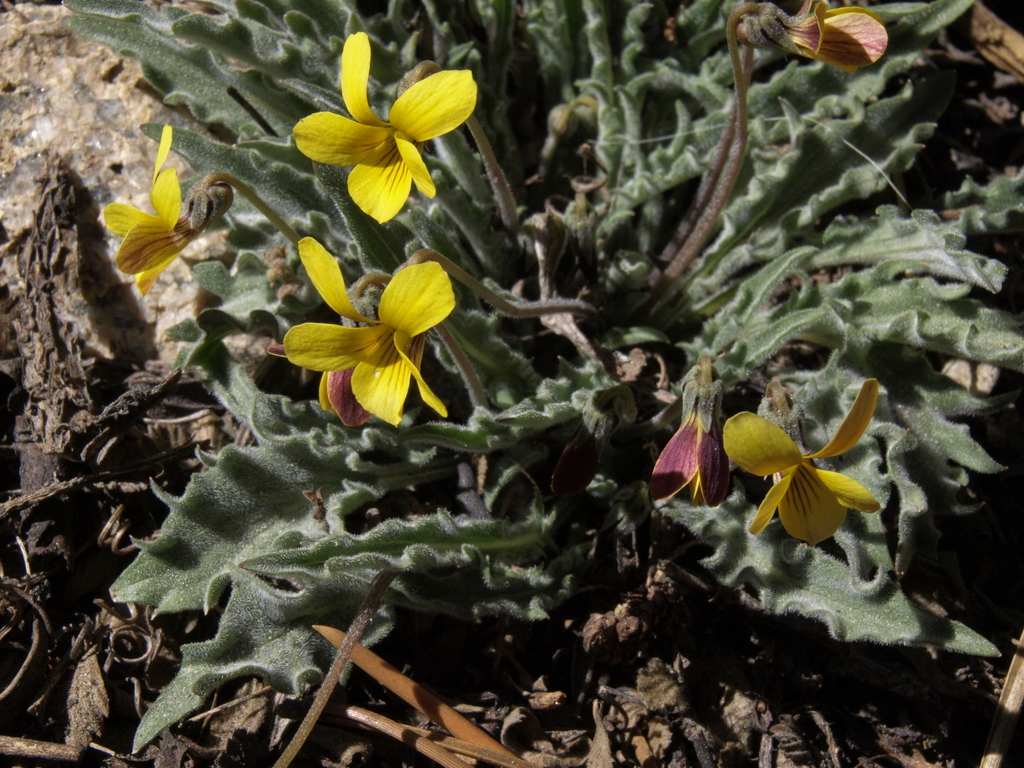
(c) Jim Morefield, some rights reserved (CC BY) · licence
Family: Violaceae · Type: Herb · Native
Conservation status: CNPS 1B.2
Viola pinetorum subsp. grisea (Gray-leaved violet) is a native California herb in the Violaceae family, recognized by . Key features: gray-woolly indument, very narrow leaves, alpine habitat.
Gray-leaved violet is a rare (CNPS 1B.2) California native perennial found in southern Sierra Nevada, Tehachapi, Western Transverse Ranges, and San Bernardan Mountains in alpine zones and mountain peaks at elevations of 1,980 to 3,700 meters. Flowering from June to July, this plant produces flowers with delicate pale coloration nestled among gray-tomentose foliage. Growing as a compact plant only 4.5 to 9.5 centimeters tall with stems generally buried and barely elongated, it has a distinctive low-growing alpine character. Its basal leaves are oblanceolate to obovate, measuring 1.7 to 4 centimeters long and 0.3 to 1 centimeter wide, with irregular serrated edges that contribute to its rugged mountain adaptation. The lowest flower petal ranges from 5 to 9 millimeters, perfectly scaled to its diminutive alpine habitat.
Identification and appearance
Key characters: 21 sympatric species. Key features: gray-woolly indument, very narrow leaves, alpine habitat
Habitat and range
Habitat: Mountain peaks, alpine zones
Elevation: 1980-3700 m
California counties: Tulare, Inyo, Kern, Monterey, Fresno, San Bernardino, Ventura
Bloom period
Viola pinetorum subsp. grisea blooms Jun-Jul.
Conservation status
CNPS 1B.2
How to tell it apart
vs Asarum: Viola flowers sit above ground on stalks; Asarum flowers hide at ground level under heart-shaped leaves.; vs Cardamine: Viola has irregular flowers with a spur; Cardamine has 4-petaled symmetrical flowers.; vs Lycianthes: Viola flowers have a backward spur; Lycianthes has star-shaped flowers with no spur.; vs Pelargonium: Viola has a petal-derived spur; Pelargonium has a sepal-derived spur fused to the flower stalk.; vs Eschscholzia: Viola has 5 petals with one forming a spur; Eschscholzia has 4 separate fan-shaped petals.
Frequently asked questions
Is Viola pinetorum subsp. grisea native to California?
Yes. Viola pinetorum subsp. grisea is native to California (recorded as native).
When does Viola pinetorum subsp. grisea bloom?
Viola pinetorum subsp. grisea blooms Jun-Jul.
Where in California does Viola pinetorum subsp. grisea grow?
Viola pinetorum subsp. grisea occurs in Tulare, Inyo, Kern, Monterey, Fresno, San Bernardino, Ventura, at elevations of 1980-3700 m.
What plant family does Viola pinetorum subsp. grisea belong to?
Viola pinetorum subsp. grisea is in the Violaceae family, genus Viola.
Is Viola pinetorum subsp. grisea rare or endangered?
Viola pinetorum subsp. grisea carries California Rare Plant Rank 1B.2, state rank S3.
Related species
Other California species in the same genus, family, or bioregion.
Sources: Jepson eFlora · CNPS Rare Plant Inventory · Index of California Plant Names · CalPhotos · CDFW CNDDB
Last updated 2026-10-08
Data from The California Species Project — 14,000+ California species with verified data from CNPS, CDFW, USFWS, Cal-IPC, and more.