Viola purpurea subsp. quercetorum
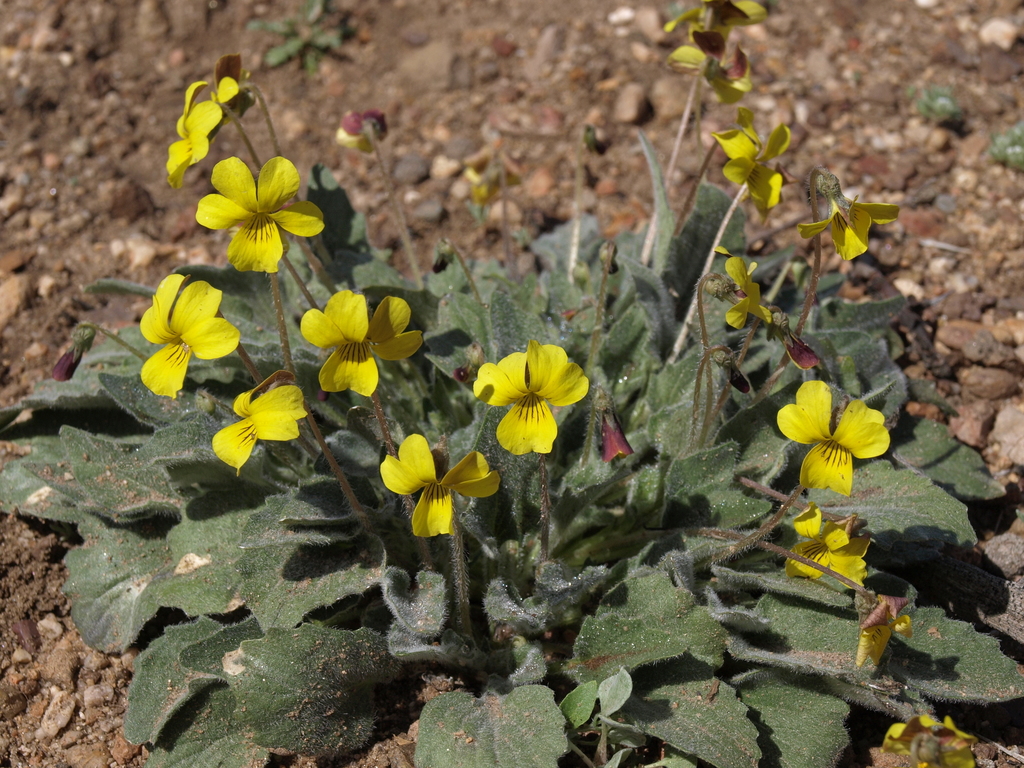
(c) Jim Morefield, some rights reserved (CC BY-SA) · licence
Family: Violaceae · Type: Herb · Native
Viola purpurea subsp. quercetorum is a native California herb in the Violaceae family, recognized by Oak woodland habitat association helps with identification.
oak woodland violet is a California native perennial found in northwestern, Cascade Range, Sierra Nevada, central western, southwestern, and Modoc Plateau bioregions in dry, grassy or brushy slopes, chaparral, and areas below yellow-pine forest at elevations of 300 to 2,000 meters. Flowering from February to July, this plant produces yellow to purple flowers with lowest petals 10 to 16 millimeters long. Growing 4 to 25 centimeters tall with spreading to erect stems that elongate by season's end, it develops puberulent foliage. Its basal leaves are ovate to round, 1 to 5 centimeters long, gray-green with occasional purple tinting and irregularly wavy-toothed edges. The cauline leaves are smaller, lanceolate to diamond-shaped, with crenate-serrate margins and tapered bases.
Identification and appearance
Key characters: Oak woodland habitat association helps with identification
Habitat and range
Habitat: Dry, grassy or brushy slopes, chaparral, generally below yellow-pine forest
Elevation: 304-1981 m
California counties: Kern, Tulare, Sacramento, San Benito, Riverside, Fresno, Lake, Los Angeles, Madera, Plumas, San Bernardino, Santa Clara, Siskiyou, Ventura, Napa, Stanislaus, San Diego, Butte, Monterey, San Luis Obispo, Mendocino, Marin, Contra Costa, El Dorado, Calaveras, Nevada, Alameda, Merced, Glenn, Shasta, Tehama, Tuolumne, Modoc, Solano, Santa Barbara, Sonoma, Mariposa, Colusa, Humboldt, Trinity, Sierra, Amador, Del Norte, Orange, San Mateo, Santa Cruz
Outside California: southwestern Oregon
Bloom period
Viola purpurea subsp. quercetorum blooms Feb-Jul.
How to tell it apart
vs Asarum: Viola flowers sit above ground on stalks; Asarum flowers hide at ground level under heart-shaped leaves.; vs Cardamine: Viola has irregular flowers with a spur; Cardamine has 4-petaled symmetrical flowers.; vs Lycianthes: Viola flowers have a backward spur; Lycianthes has star-shaped flowers with no spur.; vs Pelargonium: Viola has a petal-derived spur; Pelargonium has a sepal-derived spur fused to the flower stalk.; vs Eschscholzia: Viola has 5 petals with one forming a spur; Eschscholzia has 4 separate fan-shaped petals.
Frequently asked questions
Is Viola purpurea subsp. quercetorum native to California?
Yes. Viola purpurea subsp. quercetorum is native to California (recorded as native).
When does Viola purpurea subsp. quercetorum bloom?
Viola purpurea subsp. quercetorum blooms Feb-Jul.
Where in California does Viola purpurea subsp. quercetorum grow?
Viola purpurea subsp. quercetorum occurs in Kern, Tulare, Sacramento, San Benito, Riverside, Fresno, Lake, Los Angeles and other counties, at elevations of 304-1981 m.
What plant family does Viola purpurea subsp. quercetorum belong to?
Viola purpurea subsp. quercetorum is in the Violaceae family, genus Viola.
What habitat does Viola purpurea subsp. quercetorum grow in?
Viola purpurea subsp. quercetorum grows in Dry, grassy or brushy slopes, chaparral, generally below yellow-pine forest.
Related species
Other California species in the same genus, family, or bioregion.
Sources: Jepson eFlora · Index of California Plant Names · CalPhotos
Last updated 2026-10-07
Data from The California Species Project — 14,000+ California species with verified data from CNPS, CDFW, USFWS, Cal-IPC, and more.