Viscum album
European mistletoe
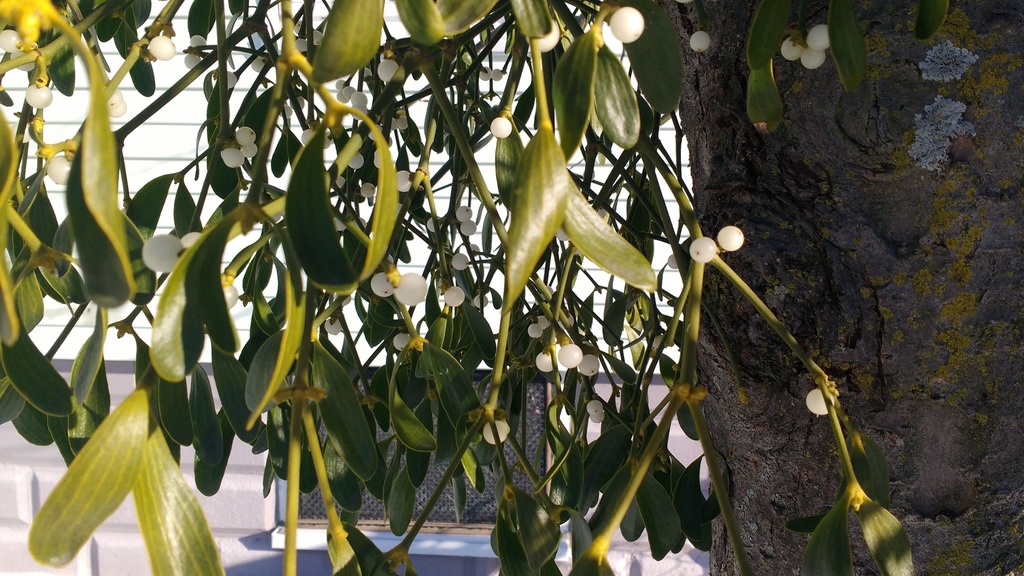
(c) Laura J. Costello, some rights reserved (CC BY) · licence
Family: Viscaceae · Type: Shrub · Not Native
Viscum album (European mistletoe) is a non-native California shrub in the Viscaceae family, recognized by European introduction with very limited establishment, only Viscum species in California.
European mistletoe is a naturalized shrub found in the northern Coast Ranges of California, specifically in Sebastopol, Santa Rosa, and Sonoma County, at elevations of 60 to 100 meters. Flowering from February to March, this plant produces small, subtle flowers in clusters of 3 to 5 blossoms. Growing with pale green stems having internodes 3 to 8 centimeters long, it develops as a parasitic aerial shrub. Its leaves are fleshy, narrowly obovate, typically 5 to 8 centimeters long and about 1.5 centimeters wide, with a short or nearly indistinct petiole. The fruit is smooth and glabrous, contributing to its distinctive appearance as a persistent parasitic plant.
Identification and appearance
Key characters: European introduction with very limited establishment, only Viscum species in California
Habitat and range
Habitat: On
Elevation: 60-100 m
Outside California: native to Eurasia
Bloom period
Viscum album blooms Feb-Mar.
How to tell it apart
vs Phoradendron: Viscum has thick waxy leaves (50-80mm) and large berries (6-10mm); Phoradendron has smaller leaves (<47mm) and berries (3-6mm).; vs Cotoneaster: Viscum grows as mistletoe parasite in tree branches; Cotoneaster is a self-rooted shrub growing from the ground.; vs Arceuthobium: Viscum has large fleshy leaves on broadleaf trees; Arceuthobium has tiny scales on needle-bearing conifers.
Frequently asked questions
Is Viscum album native to California?
No. Viscum album is not native to California (recorded as not native).
When does Viscum album bloom?
Viscum album blooms Feb-Mar.
What plant family does Viscum album belong to?
Viscum album is in the Viscaceae family, genus Viscum.
What habitat does Viscum album grow in?
Viscum album grows in On.
Related species
Other California species in the same genus, family, or bioregion.
Sources: Jepson eFlora · CalPhotos
Last updated 2026-10-07
Data from The California Species Project — 14,000+ California species with verified data from CNPS, CDFW, USFWS, Cal-IPC, and more.