Washingtonia filifera
California fan palm
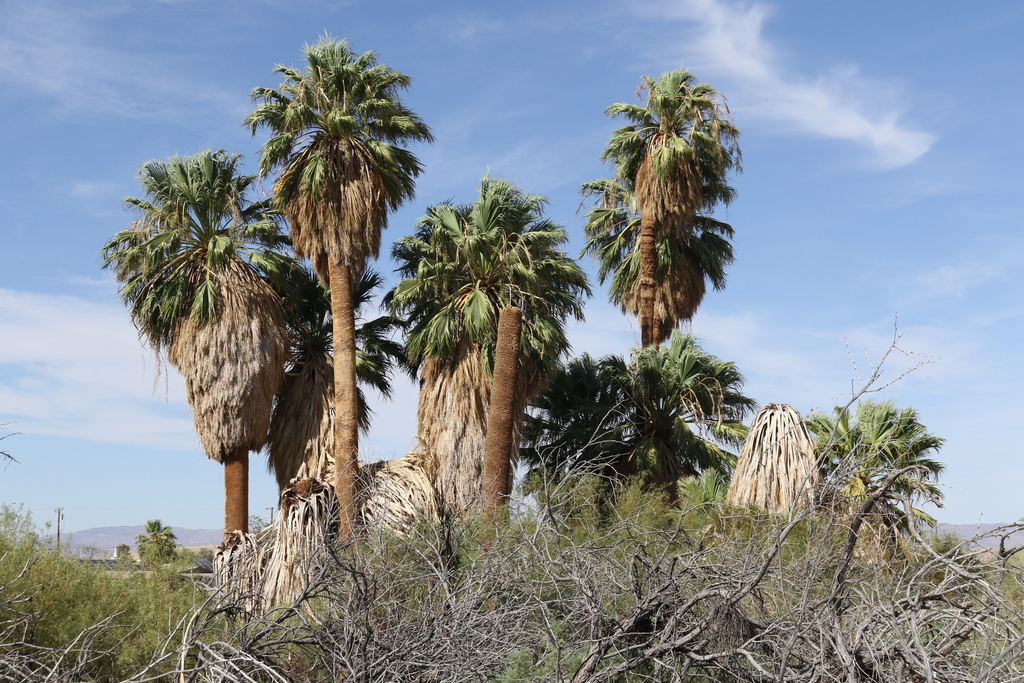
(c) Thibaud Aronson, some rights reserved (CC BY-SA), uploaded by Thibaud Aronson · licence
Family: Arecaceae · Type: Tree · Native
Washingtonia filifera (California fan palm) is a native California tree in the Arecaceae family, recognized by . Clear morphological differences in leaf size, petiole color/teeth, and fiber abundance.
California fan palm is a native shrub found in southern desert regions including the Sonoran Desert, Kern River, Santa Ana River, and Death Valley National Park at elevations below 1,200 meters in moist places, seeps, springs, and streamsides. Flowering from February to June, this palm produces white flowers in large branching clusters up to 5 meters long. Growing with a massive trunk up to 20 meters tall and nearly 1 meter in diameter, it develops distinctive green leaf stalks with sharply toothed bases. Its massive leaves extend 1.5 to 3 meters long, featuring dramatic thread-like fibers hanging from the segment margins that create a distinctive, cascading appearance. In desert environments, these palms form remarkable groves that provide critical habitat and shade in otherwise harsh landscapes.
Identification and appearance
Key characters: 1 sympatric species. Clear morphological differences in leaf size, petiole color/teeth, and fiber abundance.
Habitat and range
Habitat: Groves, moist places, seeps, springs, streamsides
Elevation: < 1200 m
California counties: Riverside, San Diego, San Bernardino, Orange, Los Angeles, Imperial, Contra Costa, Santa Barbara, Tehama, Kern, Ventura, Butte, Sacramento, San Luis Obispo
Outside California: southeastern Arizona, northern Baja California
Bloom period
Washingtonia filifera blooms Feb-Jun.
How to tell it apart
vs Sabal: Washingtonia leaf stems split at the base; Sabal leaf stems don't split and attach directly to the trunk.; vs Phoenix: Washingtonia has fan-shaped leaves; Phoenix has feather-like leaves with leaflets in rows along a central stem.; vs Trachycarpus: Washingtonia has smooth trunks (or dead leaf bases); Trachycarpus trunks are wrapped in dense brown fiber.; vs Chamaerops: Washingtonia forms single tall trunks; Chamaerops grows as a multi-stemmed shrubby clump from the base.; vs Brahea: Washingtonia has bright green leaves; Brahea has distinctly blue-gray or silvery-green waxy leaves.
Frequently asked questions
Is Washingtonia filifera native to California?
Yes. Washingtonia filifera is native to California (recorded as native).
When does Washingtonia filifera bloom?
Washingtonia filifera blooms Feb-Jun.
Where in California does Washingtonia filifera grow?
Washingtonia filifera occurs in Riverside, San Diego, San Bernardino, Orange, Los Angeles, Imperial, Contra Costa, Santa Barbara and other counties, at elevations of < 1200 m.
What plant family does Washingtonia filifera belong to?
Washingtonia filifera is in the Arecaceae family, genus Washingtonia.
What habitat does Washingtonia filifera grow in?
Washingtonia filifera grows in Groves, moist places, seeps, springs, streamsides.
Related species
Other California species in the same genus, family, or bioregion.
Sources: Jepson eFlora · Index of California Plant Names · CalPhotos
Last updated 2026-10-07
Data from The California Species Project — 14,000+ California species with verified data from CNPS, CDFW, USFWS, Cal-IPC, and more.