Woodwardia fimbriata
Giant chain fern, Giant Chain Fern
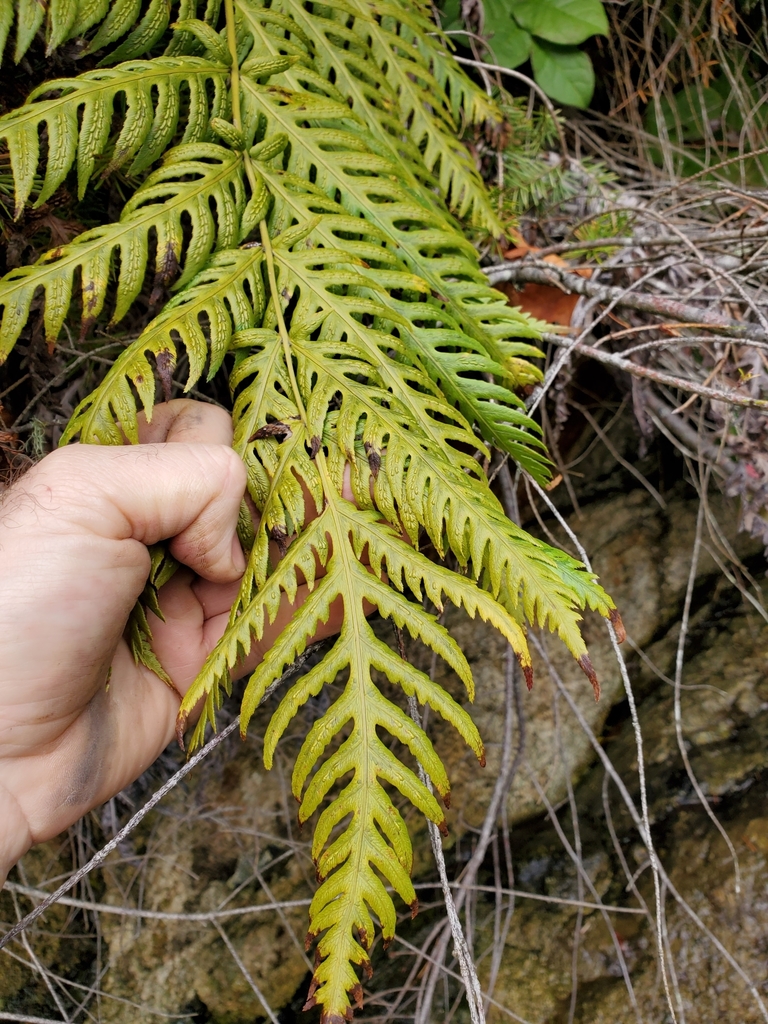
no rights reserved · CC0
Family: Blechnaceae · Type: Herb · Native
Woodwardia fimbriata (Giant chain fern) is a native California herb in the Blechnaceae family, recognized by 0 congeners; only chain fern in CA — giant 1--3 m fronds at seeps, sori in chain-like rows along midrib.
Giant chain fern is a California native perennial found in California Floristic Province (rare in Great Valley) near streams, springs, and seeps at elevations of 0 to 2,300 meters. An impressive evergreen fern with fronds generally 1 to 3 meters long, featuring large stipes 5 to 15 millimeters wide at the base covered with orange-brown to straw-colored scales. Growing with a short, stout prostrate rhizome, this fern produces pinnae 15 to 30 centimeters long that are often glandular and deeply lobed nearly to the midrib. Its fronds have a coarse texture with lower pinnae somewhat reduced, creating a distinctive layered appearance. The fern produces sporangia in sori generally 2 to 4 millimeters long, characteristic of its robust chain-like structure.
Identification and appearance
Key characters: 0 congeners; only chain fern in CA — giant 1--3 m fronds at seeps, sori in chain-like rows along midrib
Habitat and range
Habitat: Near streams, springs, seeps
Elevation: +- 0-2300 m.
California counties: San Bernardino, Riverside, Santa Clara, Tuolumne, San Mateo, Santa Cruz, San Luis Obispo, Santa Barbara, Tulare, Shasta, Placer, Stanislaus, San Diego, Ventura, Humboldt, Los Angeles, Orange, Alameda, Butte, Contra Costa, Del Norte, Fresno, Inyo, Kern, Lake, Marin, Mariposa, Mendocino, Monterey, Napa, San Francisco, Sonoma, Trinity, El Dorado, Amador, Nevada, Siskiyou, San Joaquin, Yuba, Plumas, Sutter, Tehama, Colusa, Sierra, San Benito, Merced, Calaveras
Outside California: to British Columbia, Nevada, Arizona, northwestern Mexico
How to tell it apart
vs Athyrium: Woodwardia has oblong spore clusters in chain-like rows; lady ferns have curved, J-shaped or horseshoe-shaped spore clusters.; vs Pteridium: Woodwardia spore clusters are in neat chain-like rows on frond undersides; bracken has continuous lines under rolled leaf edges.; vs Dryopteris: Woodwardia has elongated spore clusters in parallel rows; wood ferns have scattered round to kidney-shaped spore covers.; vs Polystichum: Woodwardia has smooth fronds with chain-like spore rows; sword ferns have prickly fronds with shield-shaped spore covers.; vs Polypodium: Woodwardia has elongated spore clusters in organized rows; polypody has round naked spore dots scattered irregularly.
Frequently asked questions
Is Woodwardia fimbriata native to California?
Yes. Woodwardia fimbriata is native to California (recorded as native).
Where in California does Woodwardia fimbriata grow?
Woodwardia fimbriata occurs in San Bernardino, Riverside, Santa Clara, Tuolumne, San Mateo, Santa Cruz, San Luis Obispo, Santa Barbara and other counties, at elevations of +- 0-2300 m..
What plant family does Woodwardia fimbriata belong to?
Woodwardia fimbriata is in the Blechnaceae family, genus Woodwardia.
What habitat does Woodwardia fimbriata grow in?
Woodwardia fimbriata grows in Near streams, springs, seeps.
Related species
Other California species in the same genus, family, or bioregion.
Sources: Jepson eFlora · Index of California Plant Names · CalPhotos
Last updated 2026-10-07
Data from The California Species Project — 14,000+ California species with verified data from CNPS, CDFW, USFWS, Cal-IPC, and more.