Xylorhiza tortifolia var. tortifolia
Mojave-aster
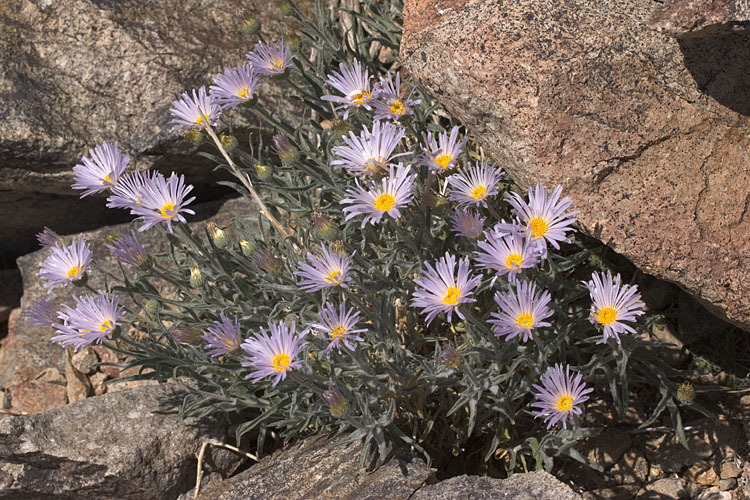
(c) David~O, some rights reserved (CC BY) · licence
Family: Asteraceae · Type: Subshrub · Native
Xylorhiza tortifolia var. tortifolia (Mojave-aster) is a native California subshrub in the Asteraceae family, recognized by wider range, herbaceous habit, and consistently hairy-glandular vestiture.
Mojave-aster is a California native perennial herb found in southern Sierra Nevada and desert regions in desert slopes, canyons, woodland, and creosote-bush scrub at elevations of 240 to 2,000 meters. Flowering from March to June and again in October, this plant produces lavender, light blue, or white ray flowers 1 to 3.3 centimeters long with distinctive ray arrangements. Growing with a much-branched woody caudex, it develops erect stems 20 to 60 centimeters tall covered in long, nonglandular hairs and shorter stalked glands. Its leaves range from 2.5 to 10 centimeters long, linear to lanceolate in shape, with acute or spine-tipped edges that are slightly spiny-dentate and softly hairy. The plant produces fruits 3 to 6 millimeters long with pappus bristles up to 9 millimeters in length.
Identification and appearance
Key characters: 2 sympatric species; distinguished by wider range, herbaceous habit, and consistently hairy-glandular vestiture
Habitat and range
Habitat: Desert slopes, canyons, woodland, creosote-bush and saltbush scrub
Elevation: 240-2000 m
Outside California: to southwestern Utah, western Arizona
Bloom period
Xylorhiza tortifolia var. tortifolia blooms Mar-Jun, Oct.
How to tell it apart
vs Erigeron: Erigeron has many thin rays in multiple rows, not fewer wide rays in one row; vs Corethrogyne: Corethrogyne has brown pappus and sterile rays; Xylorhiza has white pappus and fertile rays; vs Dieteria: Dieteria has smaller heads (under 3cm) and herbaceous stems, not woody bases; vs Trixis: Trixis has all tubular yellow flowers pointing one direction, not radial daisy heads; vs Isocoma: Isocoma lacks ray flowers entirely, having only yellow disk flowers
Frequently asked questions
Is Xylorhiza tortifolia var. tortifolia native to California?
Yes. Xylorhiza tortifolia var. tortifolia is native to California (recorded as native).
When does Xylorhiza tortifolia var. tortifolia bloom?
Xylorhiza tortifolia var. tortifolia blooms Mar-Jun, Oct.
What plant family does Xylorhiza tortifolia var. tortifolia belong to?
Xylorhiza tortifolia var. tortifolia is in the Asteraceae family, genus Xylorhiza.
What habitat does Xylorhiza tortifolia var. tortifolia grow in?
Xylorhiza tortifolia var. tortifolia grows in Desert slopes, canyons, woodland, creosote-bush and saltbush scrub.
Related species
Other California species in the same genus, family, or bioregion.
- Xylorhiza cognata — Mecca-aster
- Xylorhiza orcuttii — Orcutt's woody-aster
- Xylorhiza panamintensis — Panamint desert-aster
- Xylorhiza sp. — Desert-aster
- Xylorhiza tortifolia — Mojave-aster
- Acamptopappus shockleyi — Shockley's goldenhead
- Acamptopappus sp. — Goldenhead
- Acamptopappus sphaerocephalus — Rayless goldenhead
- Acamptopappus sphaerocephalus var. hirtellus — Hairy goldenhead
Sources: Jepson eFlora · Index of California Plant Names · CalPhotos
Last updated 2026-10-07
Data from The California Species Project — 14,000+ California species with verified data from CNPS, CDFW, USFWS, Cal-IPC, and more.