Yabea microcarpa
California hedge parsley
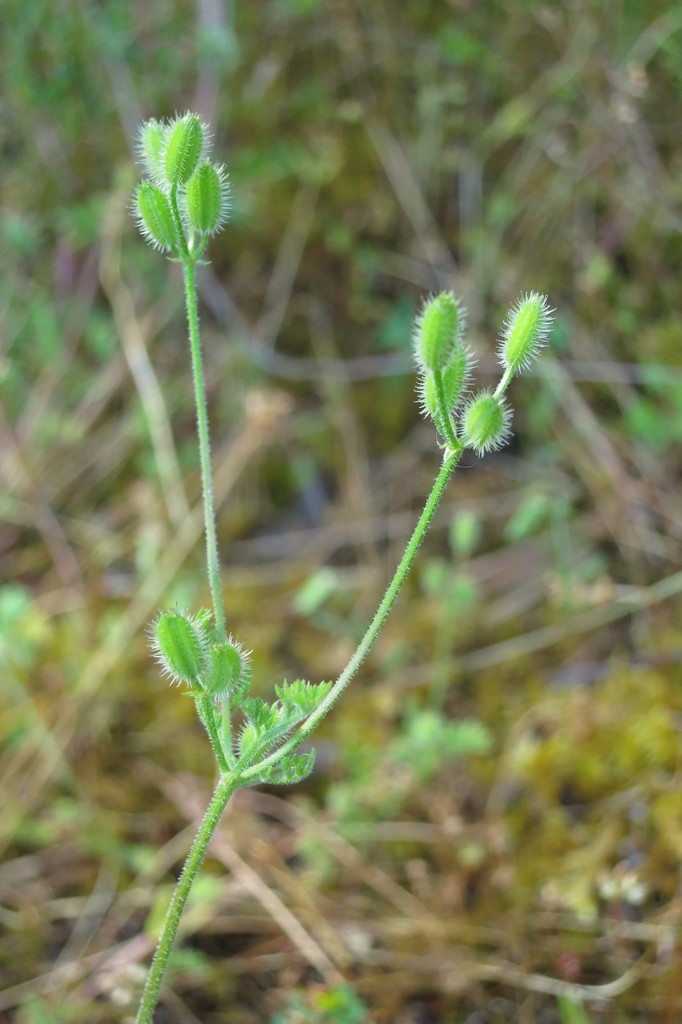
(c) Ed Alverson, some rights reserved (CC BY), uploaded by Ed Alverson · licence
Family: Apiaceae · Type: Herb · Native
Yabea microcarpa (California hedge parsley) is a native California herb in the Apiaceae family, recognized by Monotypic genus endemic to western North America, unique fruit structure in Apiaceae.
California hedge parsley is a native annual found in California Floristic Province and Mojave Desert bioregions in grassy slopes, dunes, chaparral, and woodland at elevations below 1,500 meters. Flowering from April to June, this delicate plant produces white flowers in small, compound umbels with thread-like segments. Growing with slender, erect stems 10 to 40 centimeters tall and a taproot, it has a light and airy appearance. Its pinnately dissected leaves are 2 to 6 centimeters long, with thread-like to linear segments 2 to 8 millimeters long, giving the plant a fine, lacy texture. The fruit is distinctive, with oblong compressed sides and bristly primary ribs alternating with prickly wings.
Identification and appearance
Key characters: Monotypic genus endemic to western North America, unique fruit structure in Apiaceae
Habitat and range
Habitat: Grassy slopes, dunes, chaparral, woodland
Elevation: < 1500 m
California counties: San Luis Obispo, San Bernardino, Kern, Riverside, Ventura, San Diego, Alameda, Fresno, Los Angeles, San Benito, Santa Barbara, Calaveras, Modoc, Napa, Madera, Butte, Lake, Tuolumne, Orange, San Francisco, Mendocino, Inyo, Santa Clara, Trinity, Tehama, Merced, Siskiyou, Sutter, Tulare, Imperial, Amador, Marin, El Dorado, Colusa, Contra Costa, San Joaquin, Glenn, Shasta, Santa Cruz, Monterey, Solano, Mariposa, Humboldt, Kings, Stanislaus, Nevada, Yolo, Del Norte, Sonoma, San Mateo
Outside California: to Washington, Idaho, Arizona, Baja California
Bloom period
Yabea microcarpa blooms Apr-Jun.
How to tell it apart
vs Anthriscus: Yabea has bristly side-flattened fruits; Anthriscus has smooth elongated beaked fruits.; vs Daucus: Yabea umbels stay open in fruit; Daucus umbels curl into tight bird's nests.; vs Apiastrum: Yabea has many alternate leaves and bristly fruits; Apiastrum has opposite leaves and smooth fruits.; vs Torilis: Yabea fruits are side-flattened pancakes; Torilis fruits are round burrs with prickles everywhere.; vs Ammoselinum: Yabea grows in grasslands with side-flattened fruits; Ammoselinum in deserts with oblong fruits.
Frequently asked questions
Is Yabea microcarpa native to California?
Yes. Yabea microcarpa is native to California (recorded as native).
When does Yabea microcarpa bloom?
Yabea microcarpa blooms Apr-Jun.
Where in California does Yabea microcarpa grow?
Yabea microcarpa occurs in San Luis Obispo, San Bernardino, Kern, Riverside, Ventura, San Diego, Alameda, Fresno and other counties, at elevations of < 1500 m.
What plant family does Yabea microcarpa belong to?
Yabea microcarpa is in the Apiaceae family, genus Yabea.
What habitat does Yabea microcarpa grow in?
Yabea microcarpa grows in Grassy slopes, dunes, chaparral, woodland.
Related species
Other California species in the same genus, family, or bioregion.
Sources: Jepson eFlora · Index of California Plant Names · CalPhotos
Last updated 2026-10-07
Data from The California Species Project — 14,000+ California species with verified data from CNPS, CDFW, USFWS, Cal-IPC, and more.