Zannichellia palustris
Horned pondweed
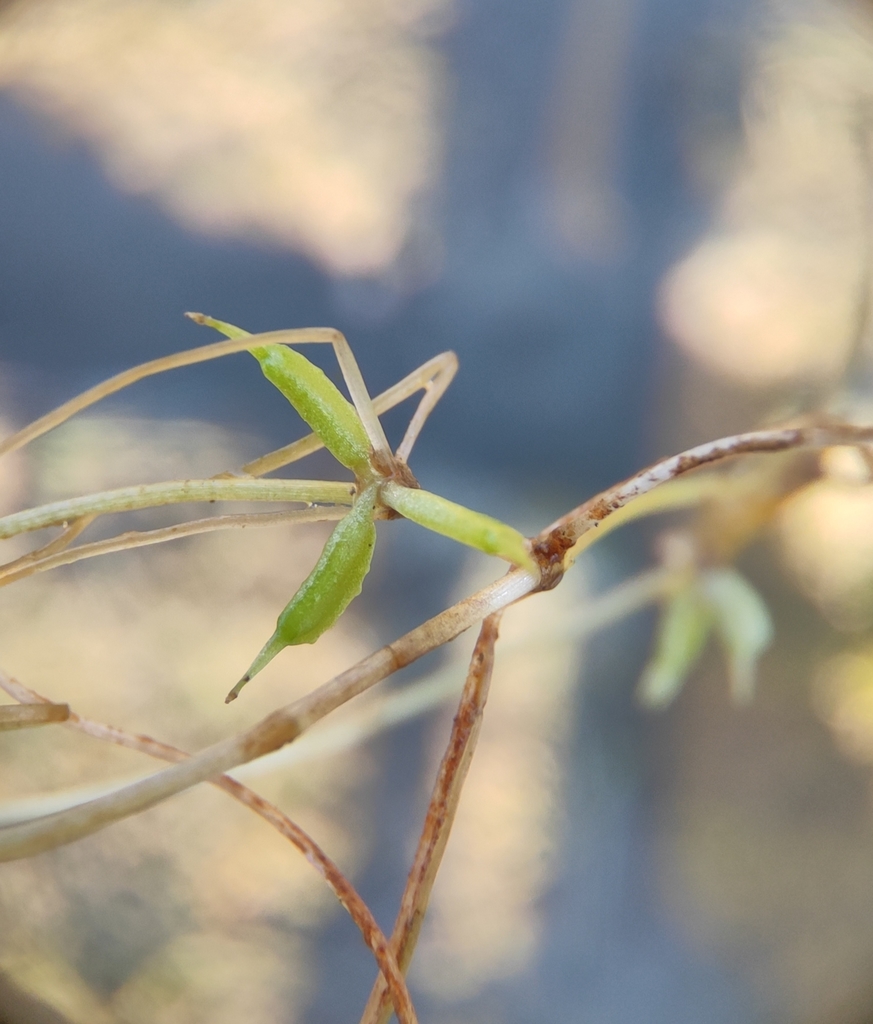
(c) Юлия, some rights reserved (CC BY), uploaded by Юлия · licence
Family: Zannichelliaceae · Type: Herb · Native
Zannichellia palustris (Horned pondweed) is a native California herb in the Zannichelliaceae family, recognized by Only Zannichellia species in California, cosmopolitan aquatic with distinctive fruit morphology.
Horned pondweed is a California native aquatic perennial found throughout much of California in streams, ponds, and lakes at elevations below 3,090 meters. Flowering from March to November, this plant produces small, inconspicuous green flowers in delicate aquatic clusters. Growing with slender stems 30 to 100 centimeters long, it spreads through shallow water with a characteristic submerged growth habit. Its narrow leaves are thread-like, less than one millimeter wide and 2 to 10 centimeters long, with sharp-pointed tips. The plant produces distinctive fruits with a small beak 1 to 1.5 millimeters long, giving it its distinctive "horned" common name.
Identification and appearance
Key characters: Only Zannichellia species in California, cosmopolitan aquatic with distinctive fruit morphology
Habitat and range
Habitat: Streams, ponds, lakes
Elevation: < 3090 m
California counties: Orange, San Bernardino, Riverside, Ventura, San Diego, Siskiyou, Inyo, Santa Barbara, Marin, Alameda, Kern, San Luis Obispo, San Mateo, Santa Clara, San Joaquin, Solano, Sutter, Contra Costa, Modoc, Sonoma, Fresno, Los Angeles, Mono, Lake, Colusa, Merced, Napa, Lassen, Mendocino, Imperial, San Benito, Santa Cruz, Monterey, San Francisco, Shasta, Butte, Tehama, Glenn, Humboldt, Plumas, Yolo
Outside California: +- worldwide.
Bloom period
Zannichellia palustris blooms Mar-Nov.
How to tell it apart
vs Stuckenia: Sago pondweed is a submersed aquatic with thread-fine leaves too, but its leaves are alternate and sheathe the stem in a tubular stipule, and its fruits ride in a stalked spike, whereas Zannichellia leaves are opposite or whorled and its beaked nutlets sit in small sessile axillary clusters.; vs Ruppia: Widgeongrass is the closest look-alike in brackish water, but its flowers and fruits are borne on stalks (often coiling peduncles) forming an umbel-like cluster raised above the leaves, while Zannichellia fruits are nearly stalkless and clustered in the axils with a straight beak.; vs Najas: Naiads have narrow submersed leaves as well, but their leaf bases are broadened and the margins minutely toothed, and each fruit holds a single seed in a thin covering, unlike Zannichellia's smooth-margined thread leaves and ribbed beaked nutlets.; vs Ceratophyllum: Coontail bears whorled leaves that are stiff and forked (dichotomously divided) with tiny teeth, whereas Zannichellia leaves are simple, soft, unbranched threads.; vs Zostera: Eelgrass is marine with flat, ribbon-like leaves several mm wide, far broader than Zannichellia's fine filiform blades.
Frequently asked questions
Is Zannichellia palustris native to California?
Yes. Zannichellia palustris is native to California (recorded as native).
When does Zannichellia palustris bloom?
Zannichellia palustris blooms Mar-Nov.
Where in California does Zannichellia palustris grow?
Zannichellia palustris occurs in Orange, San Bernardino, Riverside, Ventura, San Diego, Siskiyou, Inyo, Santa Barbara and other counties, at elevations of < 3090 m.
What plant family does Zannichellia palustris belong to?
Zannichellia palustris is in the Zannichelliaceae family, genus Zannichellia.
What habitat does Zannichellia palustris grow in?
Zannichellia palustris grows in Streams, ponds, lakes.
Related species
Other California species in the same genus, family, or bioregion.
Sources: Jepson eFlora · Index of California Plant Names · CalPhotos
Last updated 2026-10-07
Data from The California Species Project — 14,000+ California species with verified data from CNPS, CDFW, USFWS, Cal-IPC, and more.