Deschampsia bolanderi
Scribner's grass
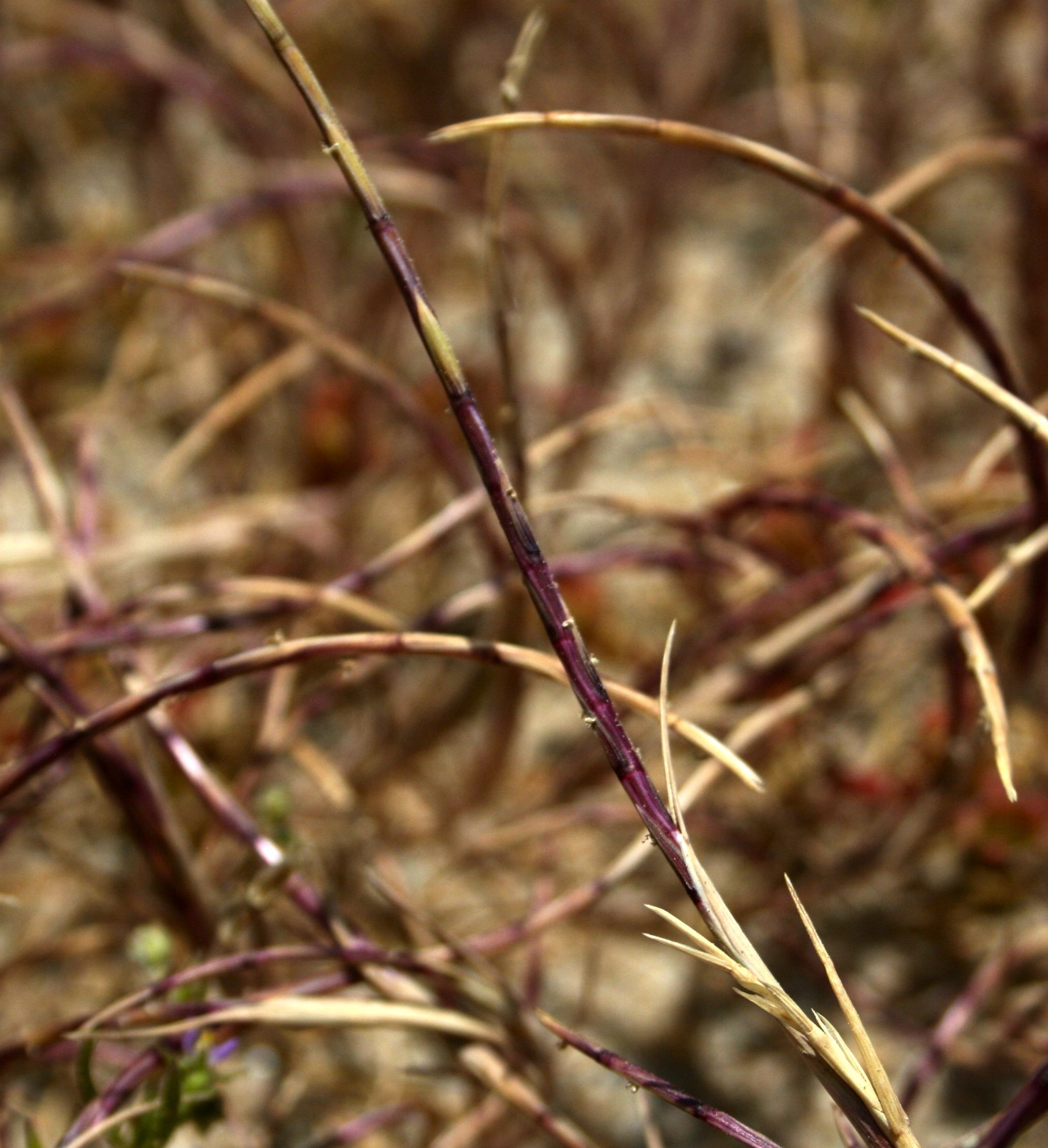
Photo by Chez Brungraber
Family: Poaceae · Type: Grass · Native
Deschampsia bolanderi (Scribner's grass) is a native California grass in the Poaceae family, recognized by annual habit, purple nodes, and dry habitat preference.
Scribner's grass is a California native annual found in the California Floristic Province and North Coast Ranges in dry, disturbed areas at elevations of 500 to 2,500 meters. Flowering from March to June, this delicate grass produces small purple-tinged spikelets with translucent, scabrous flowers. Growing 5 to 30 centimeters tall with ascending to erect stems, it features distinctive purple nodes and branching habit. Its leaf blades have scabrous margins with a prominent midrib, and translucent ligules 2 to 4 millimeters long. The plant produces small cleistogamous spikelets within leaf sheaths, with lemmas featuring a notched tip and a 2 to 4 millimeter straight awn.
Identification and appearance
Key characters: 5 sympatric species; distinguished by annual habit, purple nodes, and dry habitat preference
Habitat and range
Habitat: Dry, disturbed areas
Elevation: 500-2500 m
California counties: El Dorado, Sacramento, Yuba, Lake, Solano, Tehama, Marin, Sierra, Tulare, Tuolumne, Mariposa, San Luis Obispo, Butte, Siskiyou, Monterey, Nevada, Sonoma, Fresno, Shasta, Napa, San Joaquin, San Diego, Lassen, Santa Barbara, Mendocino, Riverside, Stanislaus, Trinity, San Bernardino, Sutter, Placer, Modoc, Calaveras, Kern, Contra Costa, Amador, Madera, San Benito, San Mateo, Santa Clara, Santa Cruz, Colusa, Humboldt, Merced
Outside California: to Washington
Bloom period
Deschampsia bolanderi blooms Mar-Jun.
How to tell it apart
vs Oloptum: Deschampsia has hairy spikelet extensions and thread-like basal leaves; Oloptum lacks the fuzzy extension and has wiry, needle-like leaves.; vs Festuca: Deschampsia has airy, open panicles with fuzzy spikelet extensions; Festuca has denser flower clusters without hairy extensions.; vs Panicum: Deschampsia forms basal leaf tufts with hairy spikelet extensions; Panicum has stem leaves and smooth, rounded spikelets.; vs Melica: Deschampsia has hairy spikelet extensions; Melica has a distinctive club-shaped sterile floret cluster at spikelet tips.; vs Poa: Deschampsia has prominent hairy extensions beyond florets; Poa has boat-shaped lemmas with cobwebby hairs at the base only.
Frequently asked questions
Is Deschampsia bolanderi native to California?
Yes. Deschampsia bolanderi is native to California (recorded as native).
When does Deschampsia bolanderi bloom?
Deschampsia bolanderi blooms Mar-Jun.
Where in California does Deschampsia bolanderi grow?
Deschampsia bolanderi occurs in El Dorado, Sacramento, Yuba, Lake, Solano, Tehama, Marin, Sierra and other counties, at elevations of 500-2500 m.
What plant family does Deschampsia bolanderi belong to?
Deschampsia bolanderi is in the Poaceae family, genus Deschampsia.
What habitat does Deschampsia bolanderi grow in?
Deschampsia bolanderi grows in Dry, disturbed areas.
Related species
Other California species in the same genus, family, or bioregion.
Sources: Jepson eFlora · Index of California Plant Names · CalPhotos
Last updated 2026-10-07
Data from The California Species Project — 14,000+ California species with verified data from CNPS, CDFW, USFWS, Cal-IPC, and more.