Lewisia taylorii
Trinity lewisia
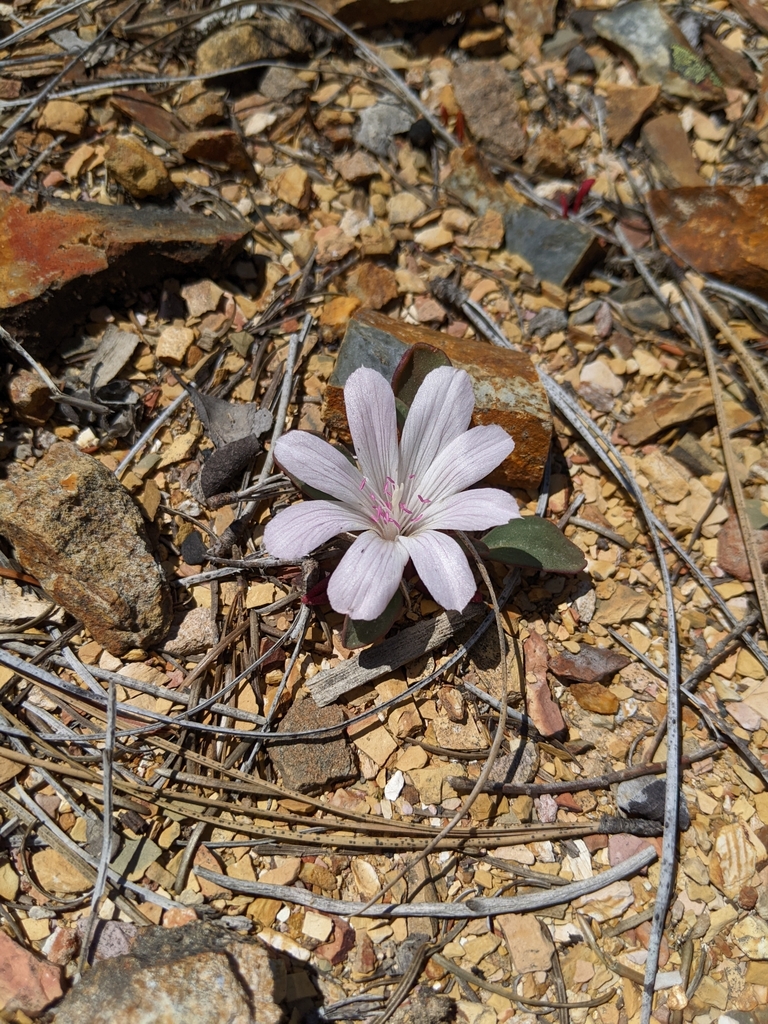
(c) Kayla Sweeten, some rights reserved (CC BY) · licence
Family: Montiaceae · Type: Perennial · Native
Conservation status: CNPS 1B.3
Lewisia taylorii (Trinity lewisia) is a native California perennial in the Montiaceae family.
Trinity lewisia is a California native perennial herb found in the Klamath Ranges bioregion in chaparral and lower montane coniferous forest on gravelly, rocky, and shale substrates at elevations from 780 to 1,275 meters. It flowers from May to June.
Habitat and range
Habitat: Chaparral, lower montane coniferous forest; gravelly, rocky, and shale substrates
Elevation: 780-1275 m
Bloom period
Lewisia taylorii blooms May-Jun.
Conservation status
CNPS 1B.3
How to tell it apart
vs Claytonia: Lewisia forms tight rosettes on rocks while Claytonia has thin leaves on upright stems in moist soil.; vs Montia: Lewisia grows from rocky crevices with succulent rosette leaves; Montia has thin stems with multiple leaves.; vs Stephanomeria: Lewisia has 5-petaled pink flowers and succulent leaves; Stephanomeria has dandelion-like ray flowers and milky sap.; vs Draba: Lewisia has pink/white 5-petaled flowers; Draba has yellow/white 4-petaled flowers in tight clusters.; vs Clarkia: Lewisia has succulent basal leaves and grows on rocks; Clarkia has upright stems with papery 4-petaled flowers.
Frequently asked questions
Is Lewisia taylorii native to California?
Yes. Lewisia taylorii is native to California (recorded as native).
When does Lewisia taylorii bloom?
Lewisia taylorii blooms May-Jun.
What plant family does Lewisia taylorii belong to?
Lewisia taylorii is in the Montiaceae family, genus Lewisia.
Is Lewisia taylorii rare or endangered?
Lewisia taylorii carries California Rare Plant Rank 1B.3, state rank S2S3.
What habitat does Lewisia taylorii grow in?
Lewisia taylorii grows in Chaparral, lower montane coniferous forest; gravelly, rocky, and shale substrates.
Related species
Other California species in the same genus, family, or bioregion.
Last updated 2026-09-30
Data from The California Species Project — 14,000+ California species with verified data from CNPS, CDFW, USFWS, Cal-IPC, and more.