Oxytheca dendroidea subsp. dendroidea
Tree-like puncturebract, Tree-Like Puncturebract
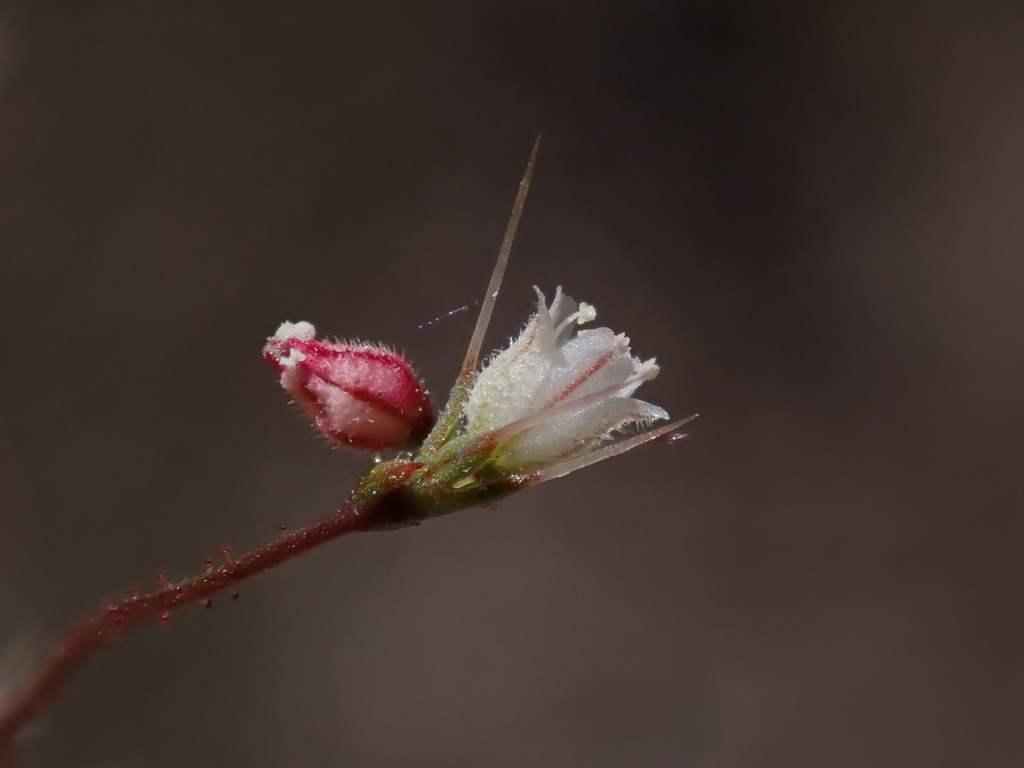
(c) Nolan Exe, some rights reserved (CC BY) · licence
Family: Polygonaceae · Type: Annual · Native
Oxytheca dendroidea subsp. dendroidea (Tree-like puncturebract) is a native California annual in the Polygonaceae family, recognized by . Key differences: leaf width, hairiness, and bract fusion.
Tree-like puncturebract is a California native annual found in southern Sierra Nevada and Great Basin bioregions on sandy or gravelly habitats at elevations of 300 to 3,000 meters. Flowering from June to October, this plant produces white to pink flowers tiny clusters, each flower approximately 1 to 2 millimeters long. Growing with erect to spreading stems 4 to 40 centimeters tall and up to 45 centimeters wide, it spreads in open, delicate formations. Its leaves are narrow and linear, 1 to 4.5 centimeters long and only 1 to 7 millimeters wide, covered with fine hairs and occasional glands. The plant's distinctive involucral bracts feature short gray awns 0.5 to 3 millimeters long, creating a delicate structural appearance.
Identification and appearance
Key characters: 1 sympatric species. Key differences: leaf width, hairiness, and bract fusion
Habitat and range
Habitat: Common. Sand or gravel
Elevation: 300-3000 m
California counties: Inyo, Mono, Lassen, Lake, Plumas
Outside California: to eastern Washington, southwestern Wyoming, eastern Nevada
Bloom period
Oxytheca dendroidea subsp. dendroidea blooms Jun-Oct.
How to tell it apart
vs Eriogonum: Oxytheca has cup-like involucres with 3-4 awns; Eriogonum has larger, awnless involucres.; vs Mucronea: Oxytheca has 3-4 awns per involucre; Mucronea has different involucre structure.; vs Claytonia: Oxytheca is in Polygonaceae with awned involucres; Claytonia is in Montiaceae with no involucres.; vs Sidotheca: Oxytheca has smooth-edged petals; Sidotheca has fringed or 3-lobed petals.; vs Acanthoscyphus: Oxytheca has 3-5 awns per involucre; Acanthoscyphus has 7-30+ awns creating bristly appearance.
Frequently asked questions
Is Oxytheca dendroidea subsp. dendroidea native to California?
Yes. Oxytheca dendroidea subsp. dendroidea is native to California (recorded as native).
When does Oxytheca dendroidea subsp. dendroidea bloom?
Oxytheca dendroidea subsp. dendroidea blooms Jun-Oct.
Where in California does Oxytheca dendroidea subsp. dendroidea grow?
Oxytheca dendroidea subsp. dendroidea occurs in Inyo, Mono, Lassen, Lake, Plumas, at elevations of 300-3000 m.
What plant family does Oxytheca dendroidea subsp. dendroidea belong to?
Oxytheca dendroidea subsp. dendroidea is in the Polygonaceae family, genus Oxytheca.
What habitat does Oxytheca dendroidea subsp. dendroidea grow in?
Oxytheca dendroidea subsp. dendroidea grows in Common. Sand or gravel.
Related species
Other California species in the same genus, family, or bioregion.
Sources: Jepson eFlora · Index of California Plant Names · CalPhotos
Last updated 2026-09-30
Data from The California Species Project — 14,000+ California species with verified data from CNPS, CDFW, USFWS, Cal-IPC, and more.