Eriogonum alexanderae
Alexander's buckwheat
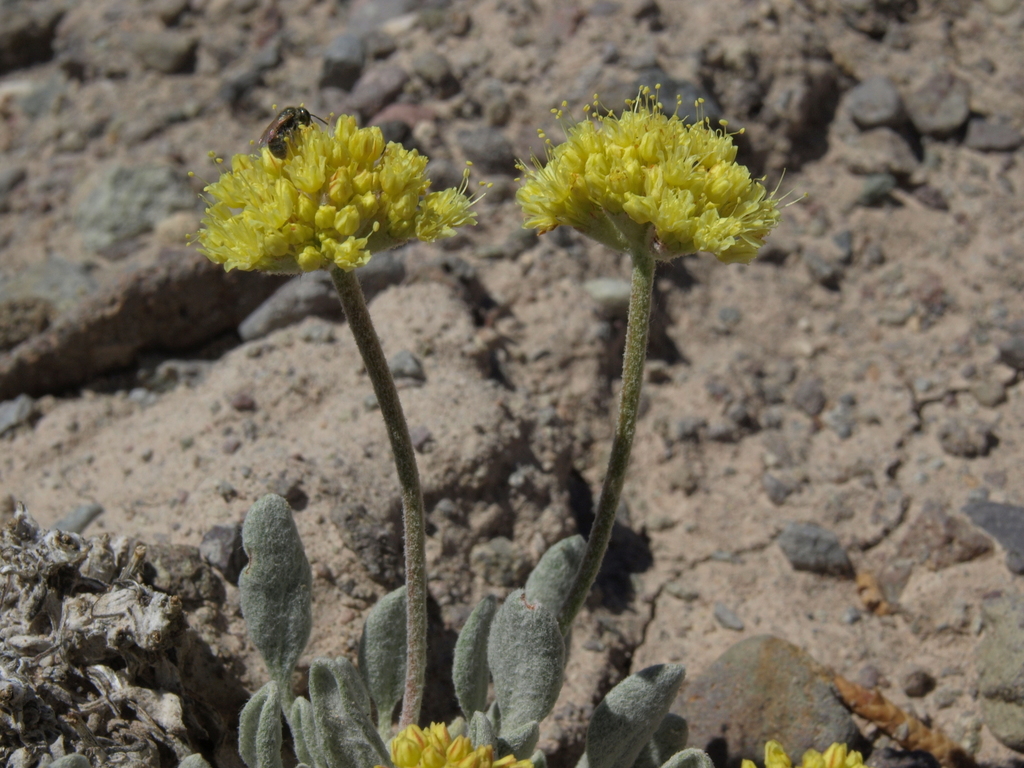
(c) Jim Morefield, some rights reserved (CC BY) · licence
Family: Polygonaceae · Type: VASC
Conservation status: CNPS 1B.1
Eriogonum alexanderae (Alexander's buckwheat) is a California vasc in the Polygonaceae family.
Alexander's buckwheat is a low, cushion- or mat-forming perennial of the western Great Basin, known from volcanic tuff hills with saltbush and sagebrush in western Nevada (Lyon, Pershing and Washoe Cos.) and, in California, only from the Mono Co. area near the Nevada line; its California occurrence is disputed — Jepson treats it as unknown in the state while CNPS ranks it 1B.1, so records should be verified. Originally described by Reveal (1985) as Eriogonum ochrocephalum var. alexanderae and later treated by FNA under E. crosbyae, it forms open to compact mats 1–8 dm across and up to 2 dm high from a much-branched woody caudex atop a stout, gnarled taproot. The leaf blades are lanceolate to narrowly ovate, 1–2 cm long, white-tomentose on both surfaces, on tomentose petioles 2–5 cm long. Its single most diagnostic feature is that the erect flowering stems, 3–10 cm long, are tomentose (hairy) — the character that separates it from var. ochrocephalum, whose stems are glabrous or glandular. The involucres are turbinate, (3.5–)4–5 mm long and 2–2.5 mm wide, rigid and tubular, tomentose on the outside, with 5–6 erect lobes. Flowers are yellow with yellowish-green midribs, 2–3 mm long, the oblong tepals united about one-third to one-half their length; stamens are exserted on filaments 3–4 mm long, pilose at the base. Achenes are light brown, 3–3.5 mm long, tapering to a long 3-angled beak.
Identification and appearance
Key characters: Differentiators are not available at this time.
Conservation status
CNPS 1B.1
How to tell it apart
vs Adenostoma: Eriogonum has flowers in cup-like involucres; Adenostoma has tiny white rose-family flowers in spikes.; vs Salvia: Eriogonum has six similar perianth parts; Salvia has two-lipped tubular flowers.; vs Fagopyrum: Eriogonum has flowers in involucred clusters; Fagopyrum has loose branching sprays without involucres.; vs Artemisia: Eriogonum has cup-surrounded flower clusters; Artemisia has tiny inconspicuous heads in drooping sprays.; vs Chorizanthe: Eriogonum has multiple flowers per involucre; Chorizanthe has one flower per involucre with spiny teeth.
Frequently asked questions
What plant family does Eriogonum alexanderae belong to?
Eriogonum alexanderae is in the Polygonaceae family, genus Eriogonum.
Is Eriogonum alexanderae rare or endangered?
Eriogonum alexanderae carries California Rare Plant Rank 1B.1, state rank S1.
Related species
Other California species in the same genus, family, or bioregion.
Sources: CDFW CNDDB
Last updated 2026-11-09
Data from The California Species Project — 14,000+ California species with verified data from CNPS, CDFW, USFWS, Cal-IPC, and more.