Chenopodium simplex
Large-seeded goosefoot
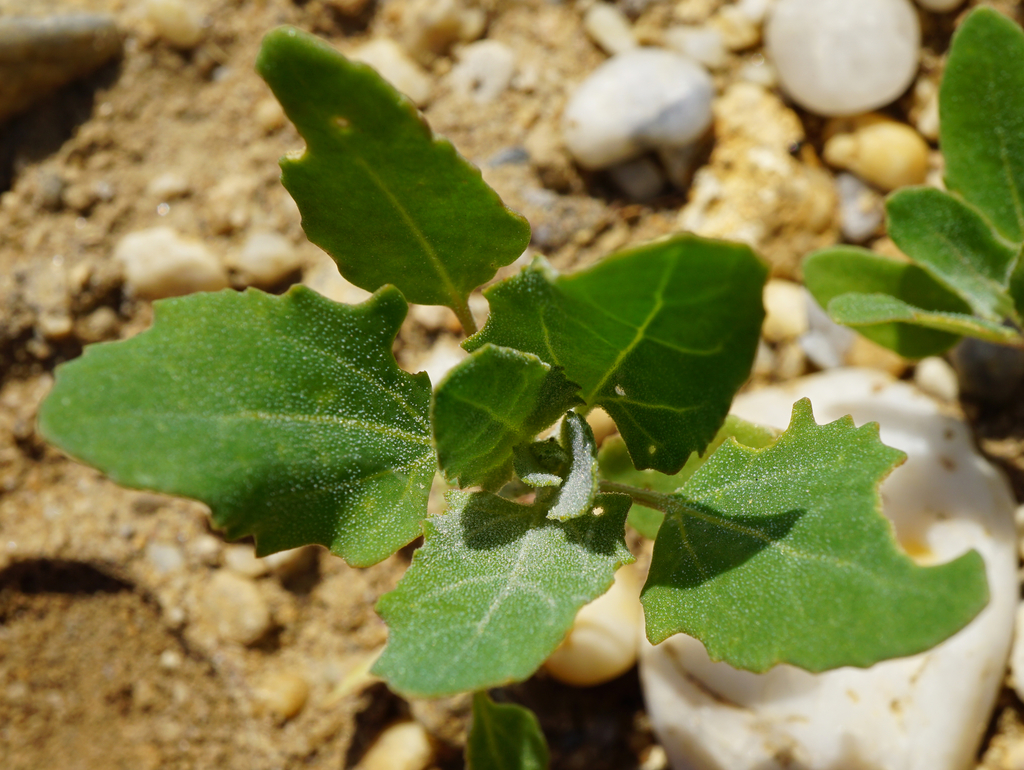
(c) Patrick Hacker, some rights reserved (CC BY), uploaded by Patrick Hacker · licence
Family: Chenopodiaceae · Type: Herb · Native
Conservation status: CNPS 4.3
Chenopodium simplex (Large-seeded goosefoot) is a native California herb in the Chenopodiaceae family, recognized by distinctive for high elevation habitat and large wavy-lobed leaves.
Large-seeded goosefoot is a California native annual found in northern Sierra Nevada, Modoc Plateau, and White and Inyo Mountains in disturbed or open places, scrub, and conifer forest at elevations of 1,400 to 2,400 meters. Flowering from July to October, this plant produces green flowers in terminal and axillary panicles with small clusters of blossoms. Growing 35 to 150 centimeters tall with few branches toward the top, it has an upright, open structure with multiple stems. Its distinctive leaves are broadly ovate to triangular, 25 to 150 millimeters long, with 3 to 5 wavy lobes and a dark green color, featuring a truncate to slightly heart-shaped base. The fruit is small, 1.5 to 3 millimeters in diameter, with a smooth surface and a seed that sits horizontally with a shiny, netted seed coat.
Identification and appearance
Key characters: 25 sympatric species; distinctive for high elevation habitat and large wavy-lobed leaves
Habitat and range
Habitat: Disturbed or open places, scrub, conifer forest
Elevation: 1400-2400 m
California counties: Inyo, San Bernardino, Modoc, Plumas, Lassen, Siskiyou
Outside California: to eastern United States
Bloom period
Chenopodium simplex blooms Jul-Oct.
Conservation status
CNPS 4.3
How to tell it apart
vs Chenopodiastrum: Chenopodium has mealy coating; Chenopodiastrum is smooth to slightly hairy without mealy texture.; vs Atriplex: Chenopodium has perfect flowers; Atriplex has separate male/female flowers with paired bracts on fruits.; vs Blitum: Chenopodium has dry fruits; Blitum has fleshy, berry-like fruiting calyxes.; vs Amaranthus: Chenopodium has mealy coating; Amaranthus is smooth with dense bristly flower spikes.; vs Rumex: Chenopodium has 5-parted flowers in clusters; Rumex has 6-parted flowers in whorls.
Frequently asked questions
Is Chenopodium simplex native to California?
Yes. Chenopodium simplex is native to California (recorded as native).
When does Chenopodium simplex bloom?
Chenopodium simplex blooms Jul-Oct.
Where in California does Chenopodium simplex grow?
Chenopodium simplex occurs in Inyo, San Bernardino, Modoc, Plumas, Lassen, Siskiyou, at elevations of 1400-2400 m.
What plant family does Chenopodium simplex belong to?
Chenopodium simplex is in the Chenopodiaceae family, genus Chenopodium.
Is Chenopodium simplex rare or endangered?
Chenopodium simplex carries California Rare Plant Rank 4.3, state rank S4.
Related species
Other California species in the same genus, family, or bioregion.
Sources: Jepson eFlora · CNPS Rare Plant Inventory · Index of California Plant Names · CalPhotos · CDFW CNDDB
Last updated 2026-10-08
Data from The California Species Project — 14,000+ California species with verified data from CNPS, CDFW, USFWS, Cal-IPC, and more.