Lythrum sp.
Loosestrife, Loosestrife
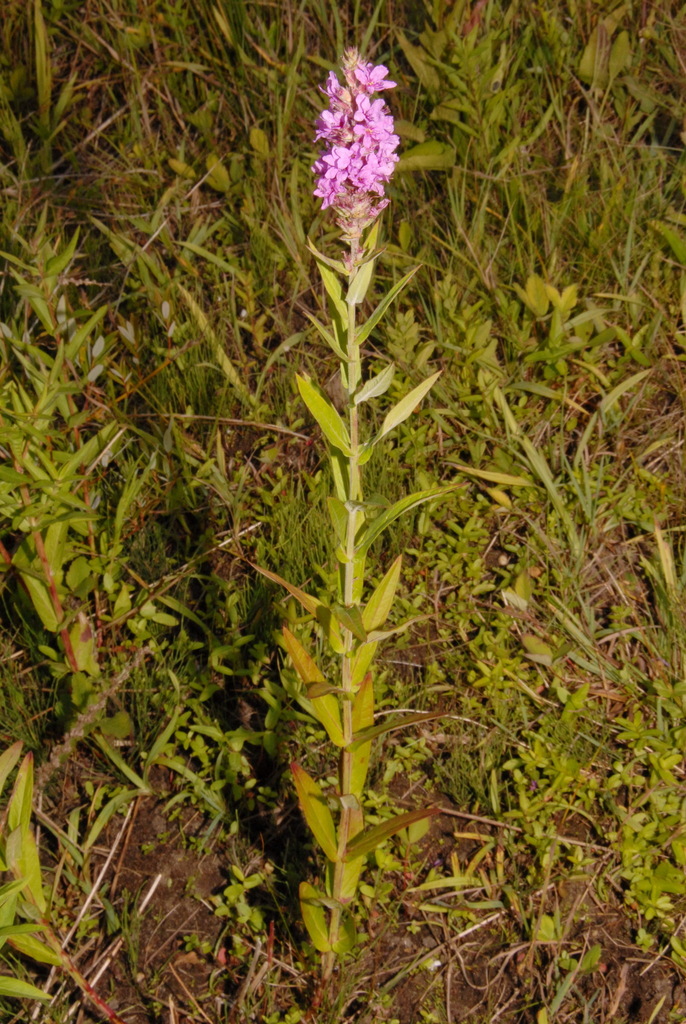
(c) Brian Finzel, some rights reserved (CC BY-SA), uploaded by Brian Finzel · licence
Family: Lythraceae · Type: Perennial · Variable; species dependent
Lythrum sp. (Loosestrife) is a non-native California perennial in the Lythraceae family.
How to tell it apart
vs Coleonema: Lythrum has tubular flower bases and wetland habitat; Coleonema has open flowers and grows in dry upland areas.; vs Cuphea: Lythrum has symmetrical cylindrical flower tubes; Cuphea has asymmetrical, curved tubular flowers.; vs Epilobium: Lythrum has cylindrical flower tubes with leaves in pairs/whorls; Epilobium has cross-shaped flowers with inferior ovaries.; vs Salvia: Lythrum has cylindrical flower tubes and smooth leaf margins; Salvia has hooded, 2-lipped flowers and square stems.; vs Lysimachia: Lythrum has distinct tubular flower bases; Lysimachia has flat, wheel-shaped flowers without tubes.
Frequently asked questions
Is Lythrum sp. native to California?
No. Lythrum sp. is not native to California (recorded as variable; species dependent).
What plant family does Lythrum sp. belong to?
Lythrum sp. is in the Lythraceae family, genus Lythrum.
Related species
Other California species in the same genus, family, or bioregion.
- Lythrum tribracteatum — Three bracted loosestrife
- Lythrum californicum — California loosestrife
- Lythrum hyssopifolia — Hyssop loosestrife
- Lythrum junceum
- Lythrum portula — Broad leaved loosestrife
- Lythrum salicaria — Purple loosestrife
- Punica granatum — Pomegranate
- Punica sp. — Pomegranate
- Rotala indica — Indian toothcup
Sources: Jepson eFlora · CalPhotos
Last updated 2026-04-14
Data from The California Species Project — 14,000+ California species with verified data from CNPS, CDFW, USFWS, Cal-IPC, and more.